AndroidSwipeableCardStack
=========================
[](https://android-arsenal.com/details/1/2724)
Change log:
Now it is compatible with api level 14
Investigating compatibility with api level 13
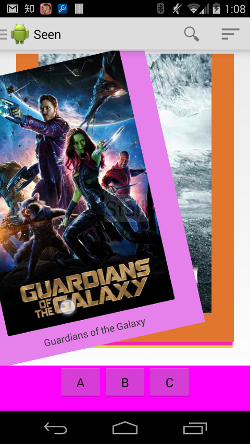
A tinder like swipeable card stack component. Provide "swipe to like" effects. Easy to customize card views.
See youtube demo : https://www.youtube.com/watch?v=YsMnLJeouf8&feature=youtu.be
A Demo App is also included in the source.
Installation
---
Use jitpack
```
repositories {
maven { url "https://jitpack.io" }
}
dependencies {
compile 'com.github.wenchaojiang:AndroidSwipeableCardStack:0.1.1'
}
```
OR manually
1. Download released .aar file
[Download current release] (https://github.com/wenchaojiang/AndroidSwipeableCardStack/releases/download/0.1.1/android-card-stack-0.1.1.aar)
2. put it into your project lib dir, "libs" for example.
3. put following lines to your gradle.build file
```
repositories {
flatDir {
dirs 'libs'
}
}
dependencies {
compile(name:'android-card-stack-0.1.0', ext:'aar')
}
```
Configuration
-----
Put CardStack in your layout file
```xml
```
Create your card view layout file.
Example: card_layout.xml, contain only a TextView
```xml
```
Implement your own adapter for the card stack. The CardStack will accept ArrayAdapter.
The Following example extends a simple ArrayAdapter, overriding ```getView()``` to supply your customized card layout
```java
public class CardsDataAdapter extends ArrayAdapter {
@Override
public View getView(int position, final View contentView, ViewGroup parent){
//supply the layout for your card
TextView v = (TextView)(contentView.findViewById(R.id.content));
v.setText(getItem(position));
return contentView;
}
}
```
Get the CardStack instance in your activity
```java
protected void onCreate(Bundle savedInstanceState) {
super.onCreate(savedInstanceState);
setContentView(R.layout.activity_my);
mCardStack = (CardStack)findViewById(R.id.container);
mCardStack.setContentResource(R.layout.card_content);
mCardStack.setStackMargin(20);
}
```
Finally, set the adapter
```java
mCardAdapter = new CardsDataAdapter(getApplicationContext(),0);
mCardAdapter.add("test1");
mCardAdapter.add("test2");
mCardAdapter.add("test3");
mCardAdapter.add("test4");
mCardAdapter.add("test5");
mCardStack.setAdapter(mCardAdapter);
```
Listening to card stack event
----
implement CardStack.CardEventListener, and set it as listener ```mCardStack.setListener(yourListener); ```
```java
Class YourListener extends CardStack.CardEventListener{
//implement card event interface
@Override
public boolean swipeEnd(int direction, float distance) {
//if "return true" the dismiss animation will be triggered
//if false, the card will move back to stack
//distance is finger swipe distance in dp
//the direction indicate swipe direction
//there are four directions
// 0 | 1
// ----------
// 2 | 3
return (distance>300)? true : false;
}
@Override
public boolean swipeStart(int direction, float distance) {
return true;
}
@Override
public boolean swipeContinue(int direction, float distanceX, float distanceY) {
return true;
}
@Override
public void discarded(int id, int direction) {
//this callback invoked when dismiss animation is finished.
}
@Override
public void topCardTapped() {
//this callback invoked when a top card is tapped by user.
}
}
```
TODO
----
1. deploy to maven central
2. compatibility with api level 13