/** * Copyright 2013 Netflix, Inc. * * Licensed under the Apache License, Version 2.0 (the "License"); * you may not use this file except in compliance with the License. * You may obtain a copy of the License at * * http://www.apache.org/licenses/LICENSE-2.0 * * Unless required by applicable law or agreed to in writing, software * distributed under the License is distributed on an "AS IS" BASIS, * WITHOUT WARRANTIES OR CONDITIONS OF ANY KIND, either express or implied. * See the License for the specific language governing permissions and * limitations under the License. */ package rx; import static org.junit.Assert.*; import static org.mockito.Matchers.*; import static org.mockito.Mockito.*; import java.util.ArrayList; import java.util.Arrays; import java.util.Collection; import java.util.List; import java.util.Map; import java.util.concurrent.CountDownLatch; import java.util.concurrent.Future; import java.util.concurrent.TimeUnit; import java.util.concurrent.atomic.AtomicInteger; import java.util.concurrent.atomic.AtomicReference; import org.junit.Before; import org.junit.Test; import org.mockito.Mock; import org.mockito.Mockito; import org.mockito.MockitoAnnotations; import rx.observables.BlockingObservable; import rx.observables.ConnectableObservable; import rx.observables.GroupedObservable; import rx.operators.OperationOnExceptionResumeNextViaObservable; import rx.operators.SafeObservableSubscription; import rx.operators.SafeObserver; import rx.operators.OperationAll; import rx.operators.OperationBuffer; import rx.operators.OperationCache; import rx.operators.OperationCombineLatest; import rx.operators.OperationConcat; import rx.operators.OperationDefer; import rx.operators.OperationDematerialize; import rx.operators.OperationFilter; import rx.operators.OperationFinally; import rx.operators.OperationGroupBy; import rx.operators.OperationMap; import rx.operators.OperationMaterialize; import rx.operators.OperationMerge; import rx.operators.OperationMergeDelayError; import rx.operators.OperationMulticast; import rx.operators.OperationObserveOn; import rx.operators.OperationOnErrorResumeNextViaFunction; import rx.operators.OperationOnErrorResumeNextViaObservable; import rx.operators.OperationOnErrorReturn; import rx.operators.OperationSample; import rx.operators.OperationScan; import rx.operators.OperationSkip; import rx.operators.OperationSubscribeOn; import rx.operators.OperationSwitch; import rx.operators.OperationSynchronize; import rx.operators.OperationTake; import rx.operators.OperationTakeLast; import rx.operators.OperationTakeUntil; import rx.operators.OperationTakeWhile; import rx.operators.OperationTimestamp; import rx.operators.OperationToObservableFuture; import rx.operators.OperationToObservableIterable; import rx.operators.OperationToObservableList; import rx.operators.OperationToObservableSortedList; import rx.operators.OperationWhere; import rx.operators.OperationZip; import rx.plugins.RxJavaErrorHandler; import rx.plugins.RxJavaObservableExecutionHook; import rx.plugins.RxJavaPlugins; import rx.subjects.PublishSubject; import rx.subjects.ReplaySubject; import rx.subjects.Subject; import rx.subscriptions.BooleanSubscription; import rx.subscriptions.Subscriptions; import rx.util.BufferClosing; import rx.util.BufferOpening; import rx.util.OnErrorNotImplementedException; import rx.util.Range; import rx.util.Timestamped; import rx.util.functions.Action0; import rx.util.functions.Action1; import rx.util.functions.Func0; import rx.util.functions.Func1; import rx.util.functions.Func2; import rx.util.functions.Func3; import rx.util.functions.Func4; import rx.util.functions.FuncN; import rx.util.functions.Function; import rx.util.functions.FunctionLanguageAdaptor; import rx.util.functions.Functions; /** * The Observable interface that implements the Reactive Pattern. *

* This interface provides overloaded methods for subscribing as well as delegate methods to the * various operators. *

* The documentation for this interface makes use of marble diagrams. The following legend explains * these diagrams: *

* *

* For more information see the RxJava * Wiki * * @param */ public class Observable { //TODO use a consistent parameter naming scheme (for example: for all operators that modify a source Observable, the parameter representing that source Observable should have the same name, e.g. "source" -- currently such parameters are named any of "sequence", "that", "source", "items", or "observable") private final static RxJavaObservableExecutionHook hook = RxJavaPlugins.getInstance().getObservableExecutionHook(); private final Func1, Subscription> onSubscribe; /** * Observable with Function to execute when subscribed to. *

* NOTE: Use {@link #create(Func1)} to create an Observable instead of this method unless you * specifically have a need for inheritance. * * @param onSubscribe * {@link Func1} to be executed when {@link #subscribe(Observer)} is called. */ protected Observable(Func1, Subscription> onSubscribe) { this.onSubscribe = onSubscribe; } protected Observable() { this(null); //TODO should this be made private to prevent it? It really serves no good purpose and only confuses things. Unit tests are incorrectly using it today } /** * An {@link Observer} must call an Observable's {@code subscribe} method in order to * receive items and notifications from the Observable. * *

A typical implementation of {@code subscribe} does the following: *

* It stores a reference to the Observer in a collection object, such as a * {@code List} object. *

* It returns a reference to the {@link Subscription} interface. This enables Observers to * unsubscribe, that is, to stop receiving items and notifications before the Observable stops * sending them, which also invokes the Observer's {@link Observer#onCompleted onCompleted} * method. *

* An Observable<T> instance is responsible for accepting all subscriptions * and notifying all Observers. Unless the documentation for a particular * Observable<T> implementation indicates otherwise, Observers should make no * assumptions about the order in which multiple Observers will receive their notifications. *

* For more information see the * RxJava Wiki * * @param observer the observer * @return a {@link Subscription} reference with which the {@link Observer} can stop receiving items * before the Observable has finished sending them * @throws IllegalArgumentException * if the {@link Observer} provided as the argument to {@code subscribe()} is * {@code null} */ public Subscription subscribe(Observer observer) { // allow the hook to intercept and/or decorate Func1, Subscription> onSubscribeFunction = hook.onSubscribeStart(this, onSubscribe); // validate and proceed if (observer == null) { throw new IllegalArgumentException("observer can not be null"); } if (onSubscribeFunction == null) { throw new IllegalStateException("onSubscribe function can not be null."); // the subscribe function can also be overridden but generally that's not the appropriate approach so I won't mention that in the exception } try { /** * See https://github.com/Netflix/RxJava/issues/216 for discussion on "Guideline 6.4: Protect calls to user code from within an operator" */ if (isInternalImplementation(observer)) { Subscription s = onSubscribeFunction.call(observer); if (s == null) { // this generally shouldn't be the case on a 'trusted' onSubscribe but in case it happens // we want to gracefully handle it the same as AtomicObservableSubscription does return hook.onSubscribeReturn(this, Subscriptions.empty()); } else { return hook.onSubscribeReturn(this, s); } } else { SafeObservableSubscription subscription = new SafeObservableSubscription(); subscription.wrap(onSubscribeFunction.call(new SafeObserver(subscription, observer))); return hook.onSubscribeReturn(this, subscription); } } catch (OnErrorNotImplementedException e) { // special handling when onError is not implemented ... we just rethrow throw e; } catch (Throwable e) { // if an unhandled error occurs executing the onSubscribe we will propagate it try { observer.onError(hook.onSubscribeError(this, e)); } catch (OnErrorNotImplementedException e2) { // special handling when onError is not implemented ... we just rethrow throw e2; } catch (Throwable e2) { // if this happens it means the onError itself failed (perhaps an invalid function implementation) // so we are unable to propagate the error correctly and will just throw RuntimeException r = new RuntimeException("Error occurred attempting to subscribe [" + e.getMessage() + "] and then again while trying to pass to onError.", e2); hook.onSubscribeError(this, r); throw r; } return Subscriptions.empty(); } } /** * An {@link Observer} must call an Observable's {@code subscribe} method in order to * receive items and notifications from the Observable. * *

A typical implementation of {@code subscribe} does the following: *

* It stores a reference to the Observer in a collection object, such as a * {@code List} object. *

* It returns a reference to the {@link Subscription} interface. This enables Observers to * unsubscribe, that is, to stop receiving items and notifications before the Observable stops * sending them, which also invokes the Observer's {@link Observer#onCompleted onCompleted} * method. *

* An {@code Observable} instance is responsible for accepting all subscriptions * and notifying all Observers. Unless the documentation for a particular * {@code Observable} implementation indicates otherwise, Observers should make no * assumptions about the order in which multiple Observers will receive their notifications. *

* For more information see the * RxJava Wiki * * @param observer the observer * @param scheduler * the {@link Scheduler} on which Observers subscribe to the Observable * @return a {@link Subscription} reference with which Observers can stop receiving items and * notifications before the Observable has finished sending them * @throws IllegalArgumentException * if an argument to {@code subscribe()} is {@code null} */ public Subscription subscribe(Observer observer, Scheduler scheduler) { return subscribeOn(scheduler).subscribe(observer); } /** * Used for protecting against errors being thrown from Observer implementations and ensuring onNext/onError/onCompleted contract compliance. *

* See https://github.com/Netflix/RxJava/issues/216 for discussion on "Guideline 6.4: Protect calls to user code from within an operator" */ private Subscription protectivelyWrapAndSubscribe(Observer o) { SafeObservableSubscription subscription = new SafeObservableSubscription(); return subscription.wrap(subscribe(new SafeObserver(subscription, o))); } @SuppressWarnings({ "rawtypes", "unchecked" }) public Subscription subscribe(final Map callbacks) { if (callbacks == null) { throw new RuntimeException("callbacks map can not be null"); } Object _onNext = callbacks.get("onNext"); if (_onNext == null) { throw new RuntimeException("'onNext' key must contain an implementation"); } // lookup and memoize onNext final FuncN onNext = Functions.from(_onNext); /** * Wrapping since raw functions provided by the user are being invoked. * * See https://github.com/Netflix/RxJava/issues/216 for discussion on "Guideline 6.4: Protect calls to user code from within an operator" */ return protectivelyWrapAndSubscribe(new Observer() { @Override public void onCompleted() { Object onComplete = callbacks.get("onCompleted"); if (onComplete != null) { Functions.from(onComplete).call(); } } @Override public void onError(Throwable e) { handleError(e); Object onError = callbacks.get("onError"); if (onError != null) { Functions.from(onError).call(e); } else { throw new OnErrorNotImplementedException(e); } } @Override public void onNext(Object args) { onNext.call(args); } }); } public Subscription subscribe(final Map callbacks, Scheduler scheduler) { return subscribeOn(scheduler).subscribe(callbacks); } @SuppressWarnings({ "rawtypes", "unchecked" }) public Subscription subscribe(final Object o) { if (o instanceof Observer) { // in case a dynamic language is not correctly handling the overloaded methods and we receive an Observer just forward to the correct method. return subscribe((Observer) o); } if (o == null) { throw new IllegalArgumentException("onNext can not be null"); } // lookup and memoize onNext final FuncN onNext = Functions.from(o); /** * Wrapping since raw functions provided by the user are being invoked. * * See https://github.com/Netflix/RxJava/issues/216 for discussion on "Guideline 6.4: Protect calls to user code from within an operator" */ return protectivelyWrapAndSubscribe(new Observer() { @Override public void onCompleted() { // do nothing } @Override public void onError(Throwable e) { handleError(e); throw new OnErrorNotImplementedException(e); } @Override public void onNext(Object args) { onNext.call(args); } }); } public Subscription subscribe(final Object o, Scheduler scheduler) { return subscribeOn(scheduler).subscribe(o); } public Subscription subscribe(final Action1 onNext) { if (onNext == null) { throw new IllegalArgumentException("onNext can not be null"); } /** * Wrapping since raw functions provided by the user are being invoked. * * See https://github.com/Netflix/RxJava/issues/216 for discussion on "Guideline 6.4: Protect calls to user code from within an operator" */ return protectivelyWrapAndSubscribe(new Observer() { @Override public void onCompleted() { // do nothing } @Override public void onError(Throwable e) { handleError(e); throw new OnErrorNotImplementedException(e); } @Override public void onNext(T args) { onNext.call(args); } }); } public Subscription subscribe(final Action1 onNext, Scheduler scheduler) { return subscribeOn(scheduler).subscribe(onNext); } @SuppressWarnings({ "rawtypes", "unchecked" }) public Subscription subscribe(final Object onNext, final Object onError) { if (onNext == null) { throw new IllegalArgumentException("onNext can not be null"); } if (onError == null) { throw new IllegalArgumentException("onError can not be null"); } // lookup and memoize onNext final FuncN onNextFunction = Functions.from(onNext); /** * Wrapping since raw functions provided by the user are being invoked. * * See https://github.com/Netflix/RxJava/issues/216 for discussion on "Guideline 6.4: Protect calls to user code from within an operator" */ return protectivelyWrapAndSubscribe(new Observer() { @Override public void onCompleted() { // do nothing } @Override public void onError(Throwable e) { handleError(e); Functions.from(onError).call(e); } @Override public void onNext(Object args) { onNextFunction.call(args); } }); } public Subscription subscribe(final Object onNext, final Object onError, Scheduler scheduler) { return subscribeOn(scheduler).subscribe(onNext, onError); } public Subscription subscribe(final Action1 onNext, final Action1 onError) { if (onNext == null) { throw new IllegalArgumentException("onNext can not be null"); } if (onError == null) { throw new IllegalArgumentException("onError can not be null"); } /** * Wrapping since raw functions provided by the user are being invoked. * * See https://github.com/Netflix/RxJava/issues/216 for discussion on "Guideline 6.4: Protect calls to user code from within an operator" */ return protectivelyWrapAndSubscribe(new Observer() { @Override public void onCompleted() { // do nothing } @Override public void onError(Throwable e) { handleError(e); onError.call(e); } @Override public void onNext(T args) { onNext.call(args); } }); } public Subscription subscribe(final Action1 onNext, final Action1 onError, Scheduler scheduler) { return subscribeOn(scheduler).subscribe(onNext, onError); } @SuppressWarnings({ "rawtypes", "unchecked" }) public Subscription subscribe(final Object onNext, final Object onError, final Object onComplete) { if (onNext == null) { throw new IllegalArgumentException("onNext can not be null"); } if (onError == null) { throw new IllegalArgumentException("onError can not be null"); } if (onComplete == null) { throw new IllegalArgumentException("onComplete can not be null"); } // lookup and memoize onNext final FuncN onNextFunction = Functions.from(onNext); /** * Wrapping since raw functions provided by the user are being invoked. * * See https://github.com/Netflix/RxJava/issues/216 for discussion on "Guideline 6.4: Protect calls to user code from within an operator" */ return protectivelyWrapAndSubscribe(new Observer() { @Override public void onCompleted() { Functions.from(onComplete).call(); } @Override public void onError(Throwable e) { handleError(e); Functions.from(onError).call(e); } @Override public void onNext(Object args) { onNextFunction.call(args); } }); } public Subscription subscribe(final Object onNext, final Object onError, final Object onComplete, Scheduler scheduler) { return subscribeOn(scheduler).subscribe(onNext, onError, onComplete); } public Subscription subscribe(final Action1 onNext, final Action1 onError, final Action0 onComplete) { if (onNext == null) { throw new IllegalArgumentException("onNext can not be null"); } if (onError == null) { throw new IllegalArgumentException("onError can not be null"); } if (onComplete == null) { throw new IllegalArgumentException("onComplete can not be null"); } /** * Wrapping since raw functions provided by the user are being invoked. * * See https://github.com/Netflix/RxJava/issues/216 for discussion on "Guideline 6.4: Protect calls to user code from within an operator" */ return protectivelyWrapAndSubscribe(new Observer() { @Override public void onCompleted() { onComplete.call(); } @Override public void onError(Throwable e) { handleError(e); onError.call(e); } @Override public void onNext(T args) { onNext.call(args); } }); } public Subscription subscribe(final Action1 onNext, final Action1 onError, final Action0 onComplete, Scheduler scheduler) { return subscribeOn(scheduler).subscribe(onNext, onError, onComplete); } /** * Returns a {@link ConnectableObservable} that upon connection causes the source Observable to * push results into the specified subject. * * @param subject * the {@link Subject} for the {@link ConnectableObservable} to push source items * into * @param * result type * @return a {@link ConnectableObservable} that upon connection causes the source Observable to * push results into the specified {@link Subject} */ public ConnectableObservable multicast(Subject subject) { return multicast(this, subject); } /** * Allow the {@link RxJavaErrorHandler} to receive the exception from onError. * * @param e */ private void handleError(Throwable e) { // onError should be rare so we'll only fetch when needed RxJavaPlugins.getInstance().getErrorHandler().handleError(e); } /** * An Observable that never sends any information to an {@link Observer}. * * This Observable is useful primarily for testing purposes. * * @param * the type of item emitted by the Observable */ private static class NeverObservable extends Observable { public NeverObservable() { super(new Func1, Subscription>() { @Override public Subscription call(Observer t1) { return Subscriptions.empty(); } }); } } /** * an Observable that invokes {@link Observer#onError onError} when the {@link Observer} * subscribes to it. * * @param * the type of item emitted by the Observable */ private static class ThrowObservable extends Observable { public ThrowObservable(final Throwable exception) { super(new Func1, Subscription>() { /** * Accepts an {@link Observer} and calls its {@link Observer#onError onError} method. * * @param observer * an {@link Observer} of this Observable * @return a reference to the subscription */ @Override public Subscription call(Observer observer) { observer.onError(exception); return Subscriptions.empty(); } }); } } /** * Creates an Observable which produces buffers of collected values. This Observable produces connected * non-overlapping buffers. The current buffer is emitted and replaced with a new buffer when the * Observable produced by the specified {@link Func0} produces a {@link BufferClosing} object. The * {@link Func0} will then be used to create a new Observable to listen for the end of the next buffer. * * @param source * The source {@link Observable} which produces values. * @param bufferClosingSelector * The {@link Func0} which is used to produce an {@link Observable} for every buffer created. * When this {@link Observable} produces a {@link BufferClosing} object, the associated buffer * is emitted and replaced with a new one. * @return * An {@link Observable} which produces connected non-overlapping buffers, which are emitted * when the current {@link Observable} created with the {@link Func0} argument produces a * {@link BufferClosing} object. */ public static Observable> buffer(Observable source, Func0> bufferClosingSelector) { return create(OperationBuffer.buffer(source, bufferClosingSelector)); } /** * Creates an Observable which produces buffers of collected values. This Observable produces buffers. * Buffers are created when the specified "bufferOpenings" Observable produces a {@link BufferOpening} object. * Additionally the {@link Func0} argument is used to create an Observable which produces {@link BufferClosing} * objects. When this Observable produces such an object, the associated buffer is emitted. * * @param source * The source {@link Observable} which produces values. * @param bufferOpenings * The {@link Observable} which when it produces a {@link BufferOpening} object, will cause * another buffer to be created. * @param bufferClosingSelector * The {@link Func0} which is used to produce an {@link Observable} for every buffer created. * When this {@link Observable} produces a {@link BufferClosing} object, the associated buffer * is emitted. * @return * An {@link Observable} which produces buffers which are created and emitted when the specified * {@link Observable}s publish certain objects. */ public static Observable> buffer(Observable source, Observable bufferOpenings, Func1> bufferClosingSelector) { return create(OperationBuffer.buffer(source, bufferOpenings, bufferClosingSelector)); } /** * Creates an Observable which produces buffers of collected values. This Observable produces connected * non-overlapping buffers, each containing "count" elements. When the source Observable completes or * encounters an error, the current buffer is emitted, and the event is propagated. * * @param source * The source {@link Observable} which produces values. * @param count * The maximum size of each buffer before it should be emitted. * @return * An {@link Observable} which produces connected non-overlapping buffers containing at most * "count" produced values. */ public static Observable> buffer(Observable source, int count) { return create(OperationBuffer.buffer(source, count)); } /** * Creates an Observable which produces buffers of collected values. This Observable produces buffers every * "skip" values, each containing "count" elements. When the source Observable completes or encounters an error, * the current buffer is emitted and the event is propagated. * * @param source * The source {@link Observable} which produces values. * @param count * The maximum size of each buffer before it should be emitted. * @param skip * How many produced values need to be skipped before starting a new buffer. Note that when "skip" and * "count" are equals that this is the same operation as {@link Observable#buffer(Observable, int)}. * @return * An {@link Observable} which produces buffers every "skipped" values containing at most * "count" produced values. */ public static Observable> buffer(Observable source, int count, int skip) { return create(OperationBuffer.buffer(source, count, skip)); } /** * Creates an Observable which produces buffers of collected values. This Observable produces connected * non-overlapping buffers, each of a fixed duration specified by the "timespan" argument. When the source * Observable completes or encounters an error, the current buffer is emitted and the event is propagated. * * @param source * The source {@link Observable} which produces values. * @param timespan * The period of time each buffer is collecting values before it should be emitted, and * replaced with a new buffer. * @param unit * The unit of time which applies to the "timespan" argument. * @return * An {@link Observable} which produces connected non-overlapping buffers with a fixed duration. */ public static Observable> buffer(Observable source, long timespan, TimeUnit unit) { return create(OperationBuffer.buffer(source, timespan, unit)); } /** * Creates an Observable which produces buffers of collected values. This Observable produces connected * non-overlapping buffers, each of a fixed duration specified by the "timespan" argument. When the source * Observable completes or encounters an error, the current buffer is emitted and the event is propagated. * * @param source * The source {@link Observable} which produces values. * @param timespan * The period of time each buffer is collecting values before it should be emitted, and * replaced with a new buffer. * @param unit * The unit of time which applies to the "timespan" argument. * @param scheduler * The {@link Scheduler} to use when determining the end and start of a buffer. * @return * An {@link Observable} which produces connected non-overlapping buffers with a fixed duration. */ public static Observable> buffer(Observable source, long timespan, TimeUnit unit, Scheduler scheduler) { return create(OperationBuffer.buffer(source, timespan, unit, scheduler)); } /** * Creates an Observable which produces buffers of collected values. This Observable produces connected * non-overlapping buffers, each of a fixed duration specified by the "timespan" argument or a maximum size * specified by the "count" argument (which ever is reached first). When the source Observable completes * or encounters an error, the current buffer is emitted and the event is propagated. * * @param source * The source {@link Observable} which produces values. * @param timespan * The period of time each buffer is collecting values before it should be emitted, and * replaced with a new buffer. * @param unit * The unit of time which applies to the "timespan" argument. * @param count * The maximum size of each buffer before it should be emitted. * @return * An {@link Observable} which produces connected non-overlapping buffers which are emitted after * a fixed duration or when the buffer has reached maximum capacity (which ever occurs first). */ public static Observable> buffer(Observable source, long timespan, TimeUnit unit, int count) { return create(OperationBuffer.buffer(source, timespan, unit, count)); } /** * Creates an Observable which produces buffers of collected values. This Observable produces connected * non-overlapping buffers, each of a fixed duration specified by the "timespan" argument or a maximum size * specified by the "count" argument (which ever is reached first). When the source Observable completes * or encounters an error, the current buffer is emitted and the event is propagated. * * @param source * The source {@link Observable} which produces values. * @param timespan * The period of time each buffer is collecting values before it should be emitted, and * replaced with a new buffer. * @param unit * The unit of time which applies to the "timespan" argument. * @param count * The maximum size of each buffer before it should be emitted. * @param scheduler * The {@link Scheduler} to use when determining the end and start of a buffer. * @return * An {@link Observable} which produces connected non-overlapping buffers which are emitted after * a fixed duration or when the buffer has reached maximum capacity (which ever occurs first). */ public static Observable> buffer(Observable source, long timespan, TimeUnit unit, int count, Scheduler scheduler) { return create(OperationBuffer.buffer(source, timespan, unit, count, scheduler)); } /** * Creates an Observable which produces buffers of collected values. This Observable starts a new buffer * periodically, which is determined by the "timeshift" argument. Each buffer is emitted after a fixed timespan * specified by the "timespan" argument. When the source Observable completes or encounters an error, the * current buffer is emitted and the event is propagated. * * @param source * The source {@link Observable} which produces values. * @param timespan * The period of time each buffer is collecting values before it should be emitted. * @param timeshift * The period of time after which a new buffer will be created. * @param unit * The unit of time which applies to the "timespan" and "timeshift" argument. * @return * An {@link Observable} which produces new buffers periodically, and these are emitted after * a fixed timespan has elapsed. */ public static Observable> buffer(Observable source, long timespan, long timeshift, TimeUnit unit) { return create(OperationBuffer.buffer(source, timespan, timeshift, unit)); } /** * Creates an Observable which produces buffers of collected values. This Observable starts a new buffer * periodically, which is determined by the "timeshift" argument. Each buffer is emitted after a fixed timespan * specified by the "timespan" argument. When the source Observable completes or encounters an error, the * current buffer is emitted and the event is propagated. * * @param source * The source {@link Observable} which produces values. * @param timespan * The period of time each buffer is collecting values before it should be emitted. * @param timeshift * The period of time after which a new buffer will be created. * @param unit * The unit of time which applies to the "timespan" and "timeshift" argument. * @param scheduler * The {@link Scheduler} to use when determining the end and start of a buffer. * @return * An {@link Observable} which produces new buffers periodically, and these are emitted after * a fixed timespan has elapsed. */ public static Observable> buffer(Observable source, long timespan, long timeshift, TimeUnit unit, Scheduler scheduler) { return create(OperationBuffer.buffer(source, timespan, timeshift, unit, scheduler)); } /** * Creates an Observable that will execute the given function when an {@link Observer} * subscribes to it. *

* *

* Write the function you pass to create so that it behaves as an Observable: It * should invoke the Observer's {@link Observer#onNext onNext}, * {@link Observer#onError onError}, and {@link Observer#onCompleted onCompleted} methods * appropriately. *

* A well-formed Observable must invoke either the Observer's onCompleted method * exactly once or its onError method exactly once. *

* See Rx Design Guidelines (PDF) * for detailed information. * * @param * the type of the items that this Observable emits * @param func * a function that accepts an {@code Observer}, invokes its * {@code onNext}, {@code onError}, and {@code onCompleted} methods * as appropriate, and returns a {@link Subscription} to allow the Observer to * canceling the subscription * @return an Observable that, when an {@link Observer} subscribes to it, will execute the given * function */ public static Observable create(Func1, Subscription> func) { return new Observable(func); } /** * Creates an Observable that will execute the given function when an {@link Observer} * subscribes to it. *

* *

* This method accepts {@link Object} to allow different languages to pass in methods using * {@link FunctionLanguageAdaptor}. *

* Write the function you pass to create so that it behaves as an Observable: It * should invoke the Observer's {@link Observer#onNext onNext}, * {@link Observer#onError onError}, and {@link Observer#onCompleted onCompleted} methods * appropriately. *

* A well-formed Observable must invoke either the Observer's onCompleted method * exactly once or its onError method exactly once. *

* See Rx Design Guidelines (PDF) * for detailed information. * * @param * the type of the items that this Observable emits * @param func * a function that accepts an {@code Observer}, invokes its * {@code onNext}, {@code onError}, and {@code onCompleted} methods * as appropriate, and returns a {@link Subscription} that allows the Observer to * cancel the subscription * @return an Observable that, when an {@link Observer} subscribes to it, will execute the given * function */ public static Observable create(final Object func) { @SuppressWarnings("rawtypes") final FuncN _f = Functions.from(func); return create(new Func1, Subscription>() { @Override public Subscription call(Observer t1) { return (Subscription) _f.call(t1); } }); } /** * Returns an Observable that emits no data to the {@link Observer} and immediately invokes * its {@link Observer#onCompleted onCompleted} method. *

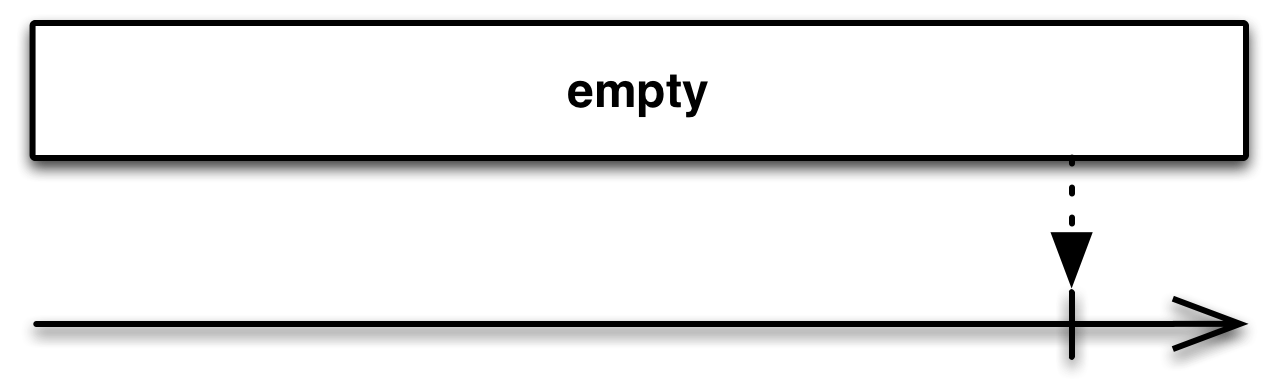
* * * @param * the type of the items (ostensibly) emitted by the Observable * @return an Observable that returns no data to the {@link Observer} and immediately invokes * the {@link Observer}'s {@link Observer#onCompleted() onCompleted} method */ public static Observable empty() { return toObservable(new ArrayList()); } /** * Returns an Observable that invokes an {@link Observer}'s {@link Observer#onError onError} * method when the Observer subscribes to it *
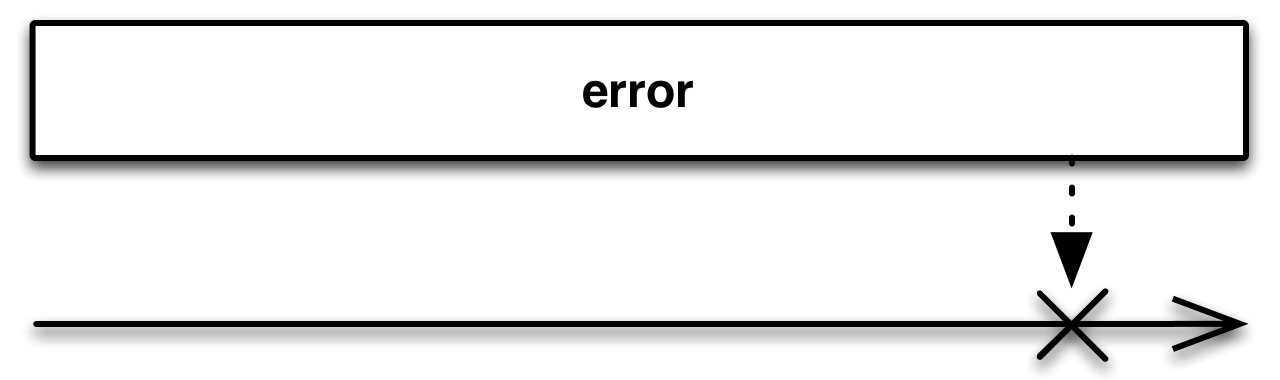
* * * @param exception * the particular error to report * @param * the type of the items (ostensibly) emitted by the Observable * @return an Observable that invokes the {@link Observer}'s * {@link Observer#onError onError} method when the Observer subscribes to it */ public static Observable error(Throwable exception) { return new ThrowObservable(exception); } /** * Filters an Observable by discarding any items it emits that do not satisfy some predicate. *
* * * @param that * the Observable to filter * @param predicate * a function that evaluates the items emitted by the source Observable, returning * {@code true} if they pass the filter * @return an Observable that emits only those items emitted by the source Observable for which the * predicate evaluates to {@code true} */ public static Observable filter(Observable that, Func1 predicate) { return create(OperationFilter.filter(that, predicate)); } /** * Filters an Observable by discarding any items it emits that do not satisfy some predicate *

* * * @param that * the Observable to filter * @param function * a function that evaluates an item emitted by the source Observable, and * returns {@code true} if it passes the filter * @return an Observable that emits only those items emitted by the source Observable for which the * predicate function evaluates to {@code true} */ public static Observable filter(Observable that, final Object function) { @SuppressWarnings("rawtypes") final FuncN _f = Functions.from(function); return filter(that, new Func1() { @Override public Boolean call(T t1) { return (Boolean) _f.call(t1); } }); } /** * Filters an Observable by discarding any items it emits that do not satisfy some predicate *
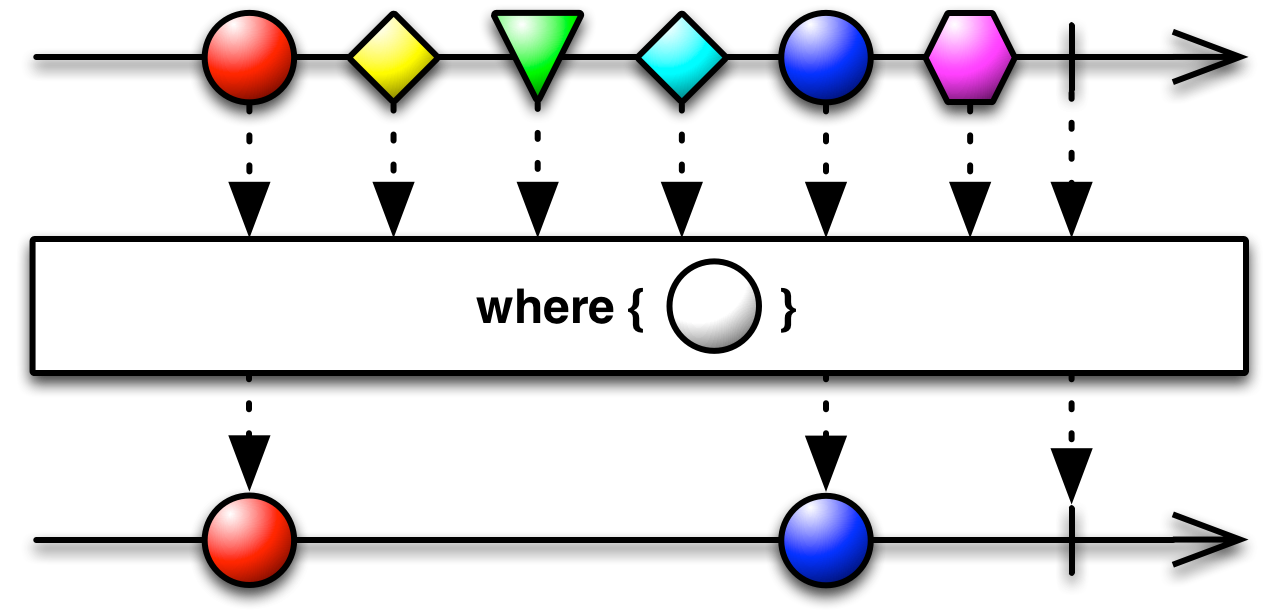
* * * @param that * the Observable to filter * @param predicate * a function that evaluates an item emitted by the source Observable, and * returns {@code true} if it passes the filter * @return an Observable that emits only those items emitted by the source Observable for which * the predicate evaluates to {@code true} */ public static Observable where(Observable that, Func1 predicate) { return create(OperationWhere.where(that, predicate)); } /** * Converts an {@link Iterable} sequence into an Observable. *

* * *

Implementation note: the entire iterable sequence will be immediately emitted each time an * {@link Observer} subscribes. Since this occurs before the {@link Subscription} is returned, * it in not possible to unsubscribe from the sequence before it completes. * * @param iterable * the source {@link Iterable} sequence * @param * the type of items in the {@link Iterable} sequence and the type of items to be * emitted by the resulting Observable * @return an Observable that emits each item in the source {@link Iterable} sequence * @see #toObservable(Iterable) */ public static Observable from(Iterable iterable) { return toObservable(iterable); } /** * Converts an Array into an Observable. *

* * *

Implementation note: the entire array will be immediately emitted each time an * {@link Observer} subscribes. Since this occurs before the {@link Subscription} is returned, * it in not possible to unsubscribe from the sequence before it completes. * * @param items * the source Array * @param * the type of items in the Array, and the type of items to be emitted by the * resulting Observable * @return an Observable that emits each item in the source Array * @see #toObservable(Object...) */ public static Observable from(T... items) { return toObservable(items); } /** * Generates an Observable that emits a sequence of integers within a specified range. *

* * *

Implementation note: the entire range will be immediately emitted each time an * {@link Observer} subscribes. Since this occurs before the {@link Subscription} is returned, * it in not possible to unsubscribe from the sequence before it completes. * * @param start * the value of the first integer in the sequence * @param count * the number of sequential integers to generate * * @return an Observable that emits a range of sequential integers * * @see Observable.Range Method (Int32, Int32) */ public static Observable range(int start, int count) { return from(Range.createWithCount(start, count)); } /** * Asynchronously subscribes and unsubscribes Observers on the specified {@link Scheduler}. *

* * * @param source * the source Observable * @param scheduler * the {@link Scheduler} to perform subscription and unsubscription actions on * @param * the type of the items emitted by the Observable * @return the source Observable modified so that its subscriptions and unsubscriptions happen * on the specified {@link Scheduler} */ public static Observable subscribeOn(Observable source, Scheduler scheduler) { return create(OperationSubscribeOn.subscribeOn(source, scheduler)); } /** * Asynchronously notify Observers on the specified {@link Scheduler}. *

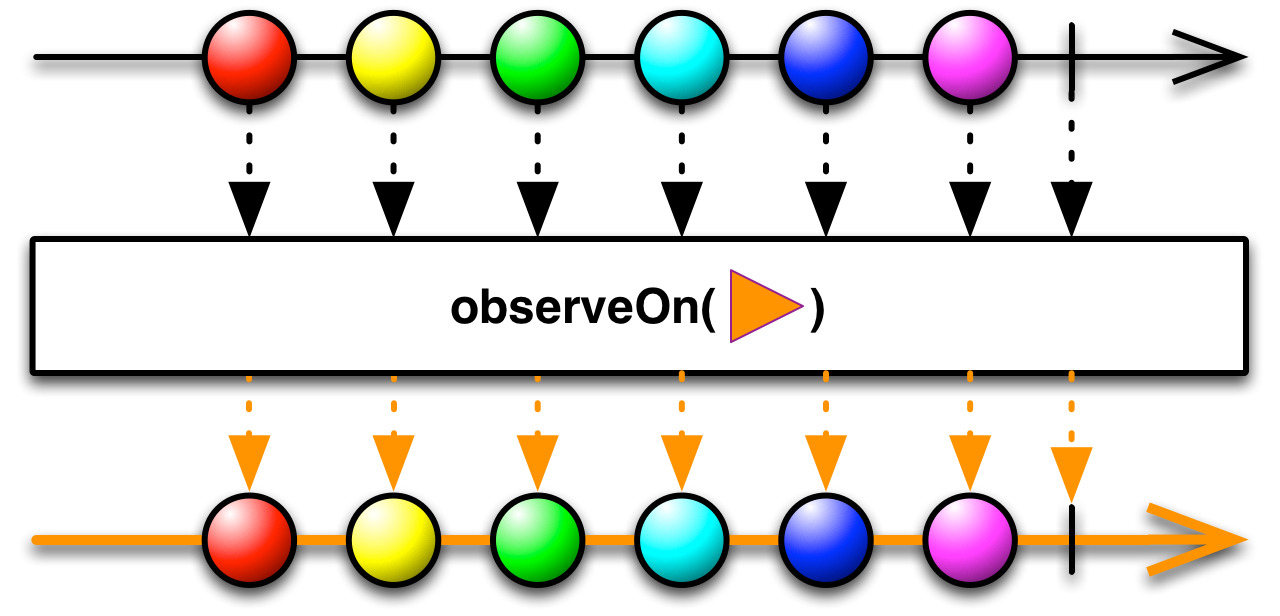
* * * @param source * the source Observable * @param scheduler * the {@link Scheduler} to notify Observers on * @param * the type of the items emitted by the Observable * @return the source Observable modified so that its Observers are notified on the specified * {@link Scheduler} */ public static Observable observeOn(Observable source, Scheduler scheduler) { return create(OperationObserveOn.observeOn(source, scheduler)); } /** * Returns an Observable that calls an Observable factory to create its Observable for each * new Observer that subscribes. That is, for each subscriber, the actuall Observable is determined * by the factory function. * *
* *

* The defer operator allows you to defer or delay emitting items from an Observable until such * time as an Observer subscribes to the Observable. This allows an {@link Observer} to easily * obtain updates or a refreshed version of the sequence. * * @param observableFactory * the Observable factory function to invoke for each {@link Observer} that * subscribes to the resulting Observable * @param * the type of the items emitted by the Observable * @return an Observable whose {@link Observer}s trigger an invocation of the given Observable * factory function */ public static Observable defer(Func0> observableFactory) { return create(OperationDefer.defer(observableFactory)); } /** * Returns an Observable that calls an Observable factory to create its Observable for each * new Observer that subscribes. *

* *

* The defer operator allows you to defer or delay emitting items from an Observable * until such time as an {@link Observer} subscribes to the Observable. This allows an Observer * to easily obtain an updates or refreshed version of the sequence. * * @param observableFactory * the Observable factory function to invoke for each {@link Observer} that * subscribes to the resulting Observable * @param * the type of the items emitted by the Observable * @return an Observable whose {@link Observer}s trigger an invocation of the given Observable * factory function */ public static Observable defer(Object observableFactory) { @SuppressWarnings("rawtypes") final FuncN _f = Functions.from(observableFactory); return create(OperationDefer.defer(new Func0>() { @Override @SuppressWarnings("unchecked") public Observable call() { return (Observable) _f.call(); } })); } /** * Returns an Observable that emits a single item and then completes. *

* *
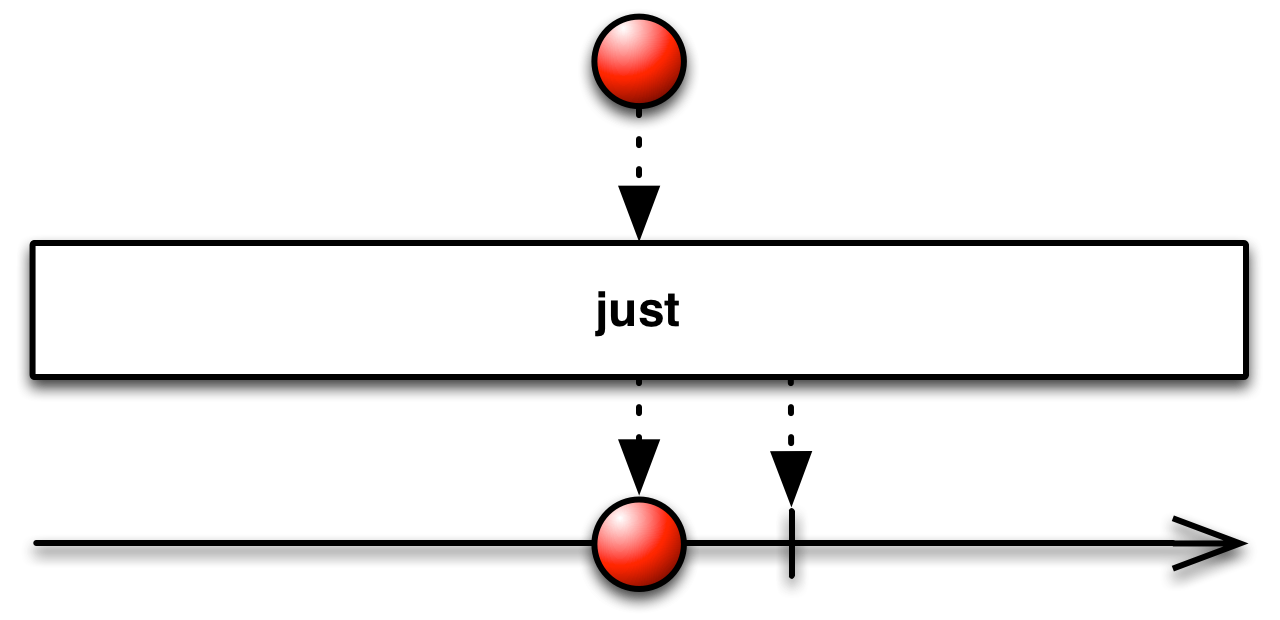
* To convert any object into an Observable that emits that object, pass that object into the * just method. *

* This is similar to the {@link #from(java.lang.Object[])} method, except that * from() will convert an {@link Iterable} object into an Observable that emits * each of the items in the Iterable, one at a time, while the just() method * converts an Iterable into an Observable that emits the entire Iterable as a single item. * * @param value * the item to pass to the {@link Observer}'s {@link Observer#onNext onNext} method * @param * the type of that item * @return an Observable that emits a single item and then completes */ public static Observable just(T value) { List list = new ArrayList(); list.add(value); return toObservable(list); } /** * Returns an Observable that applies a function of your choosing to each item emitted by an * Observable and emits the result. *

* * * @param sequence * the source Observable * @param func * a function to apply to each item emitted by the source Observable * @param * the type of items emitted by the the source Observable * @param * the type of items to be emitted by the resulting Observable * @return an Observable that emits the items from the source Observable as transformed by the * given function */ public static Observable map(Observable sequence, Func1 func) { return create(OperationMap.map(sequence, func)); } /** * Returns an Observable that applies the given function to each item emitted by an * Observable and emits the result. *

* * * @param sequence * the source Observable * @param func * a function to apply to each item emitted by the source Observable * @param * the type of items emitted by the the source Observable * @param * the type of items to be emitted by the resulting Observable * @return an Observable that emits the items from the source Observable as transformed by the * given function */ public static Observable map(Observable sequence, final Object func) { @SuppressWarnings("rawtypes") final FuncN _f = Functions.from(func); return map(sequence, new Func1() { @SuppressWarnings("unchecked") @Override public R call(T t1) { return (R) _f.call(t1); } }); } /** * Creates a new Observable by applying a function that you supply to each item emitted by * the source Observable, where that function returns an Observable, and then merging those * resulting Observables and emitting the results of this merger. *

* *
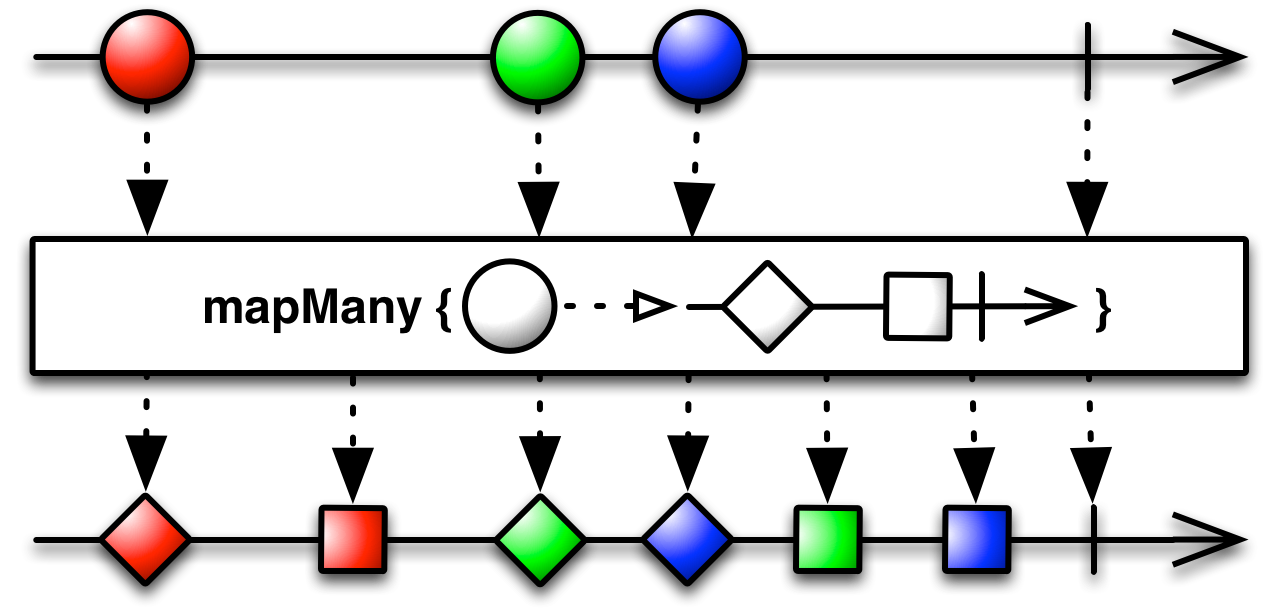
* Note: {@code mapMany} and {@code flatMap} are equivalent. * * @param sequence * the source Observable * @param func * a function that, when applied to an item emitted by the source Observable, * returns an Observable * @param * the type of items emitted by the source Observable * @param * the type of items emitted by the Observables that are returned from * {@code func} * @return an Observable that emits the result of applying the transformation function to each * item emitted by the source Observable and merging the results of the Observables * obtained from this transformation * @see #flatMap(Observable, Func1) */ public static Observable mapMany(Observable sequence, Func1> func) { return create(OperationMap.mapMany(sequence, func)); } /** * Creates a new Observable by applying a function that you supply to each item emitted by * the source Observable, where that function returns an Observable, and then merging those * resulting Observables and emitting the results of this merger. *

* *

* Note: {@code mapMany} and {@code flatMap} are equivalent. * * @param sequence * the source Observable * @param func * a function that, when applied to each item emitted by the source Observable, * generates an Observable * @param * the type of items emitted by the source Observable * @param * the type of items emitted by the Observables that are returned from * {@code func} * @return an Observable that emits the result of applying the transformation function to each * item emitted by the source Observable and merging the results of the Observables * obtained from this transformation */ public static Observable mapMany(Observable sequence, final Object func) { @SuppressWarnings("rawtypes") final FuncN _f = Functions.from(func); return mapMany(sequence, new Func1() { @SuppressWarnings("unchecked") @Override public R call(T t1) { return (R) _f.call(t1); } }); } /** * Turns all of the notifications from a source Observable into {@link Observer#onNext onNext} * emissions, and marks them with their original notification types within {@link Notification} * objects. *

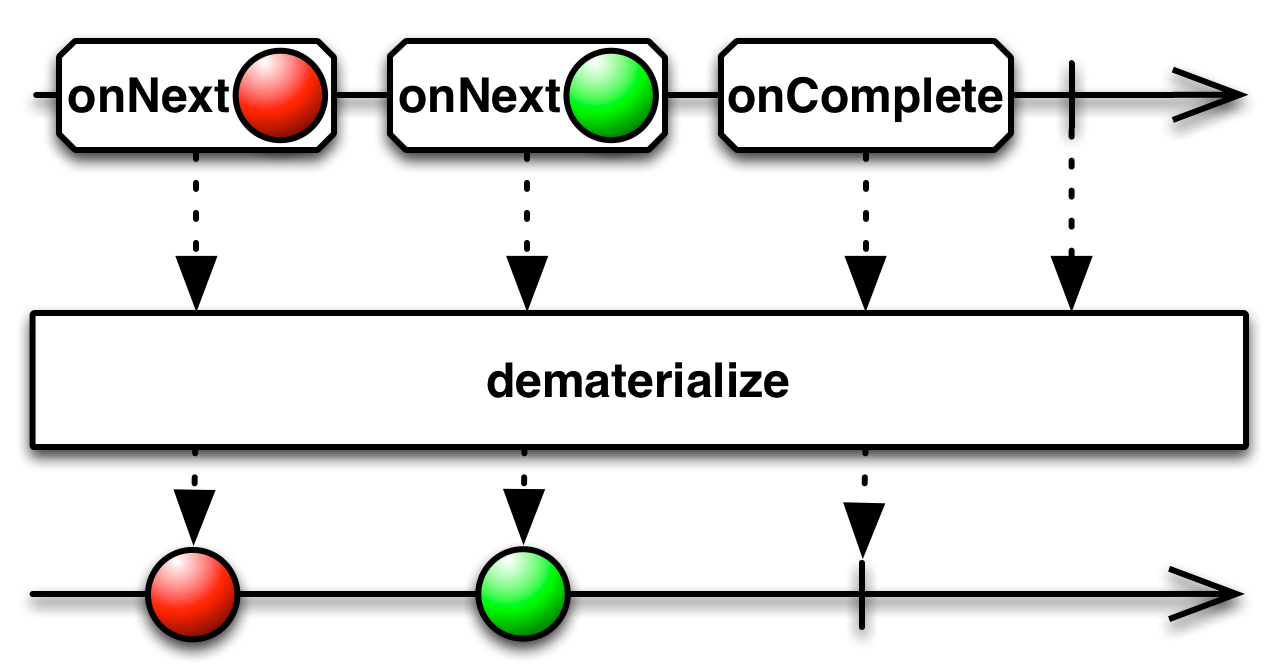
* * * @param sequence * the Observable you want to materialize in this way * @return an Observable that emits items that are the result of materializing the * notifications of the source Observable. * @see MSDN: Observable.Materialize */ public static Observable> materialize(final Observable sequence) { return create(OperationMaterialize.materialize(sequence)); } /** * Reverses the effect of {@link #materialize materialize} by transforming the * {@link Notification} objects emitted by a source Observable into the items or notifications * they represent. *

* * * @param sequence * an Observable that emits {@link Notification} objects that represent the items and * notifications emitted by an Observable * @return an Observable that emits the items and notifications embedded in the * {@link Notification} objects emitted by the source Observable * @see MSDN: Observable.Dematerialize */ public static Observable dematerialize(final Observable> sequence) { return create(OperationDematerialize.dematerialize(sequence)); } /** * Flattens a list of Observables into one Observable, without any transformation. *
* *

* You can combine the items emitted by multiple Observables so that they act like a single * Observable, by using the merge method. * * @param source * a list of Observables * @return an Observable that emits items that are the result of flattening the * {@code source} list of Observables * @see MSDN: Observable.Merge */ public static Observable merge(List> source) { return create(OperationMerge.merge(source)); } /** * Flattens a sequence of Observables emitted by an Observable into one Observable, without any * transformation. *

* *

* You can combine the items emitted by multiple Observables so that they act like a single * Observable, by using the {@code merge} method. * * @param source * an Observable that emits Observables * @return an Observable that emits items that are the result of flattening the items emitted * by the Observables emitted by the {@code source} Observable * @see MSDN: Observable.Merge Method */ public static Observable merge(Observable> source) { return create(OperationMerge.merge(source)); } /** * Flattens a series of Observables into one Observable, without any transformation. *

* *

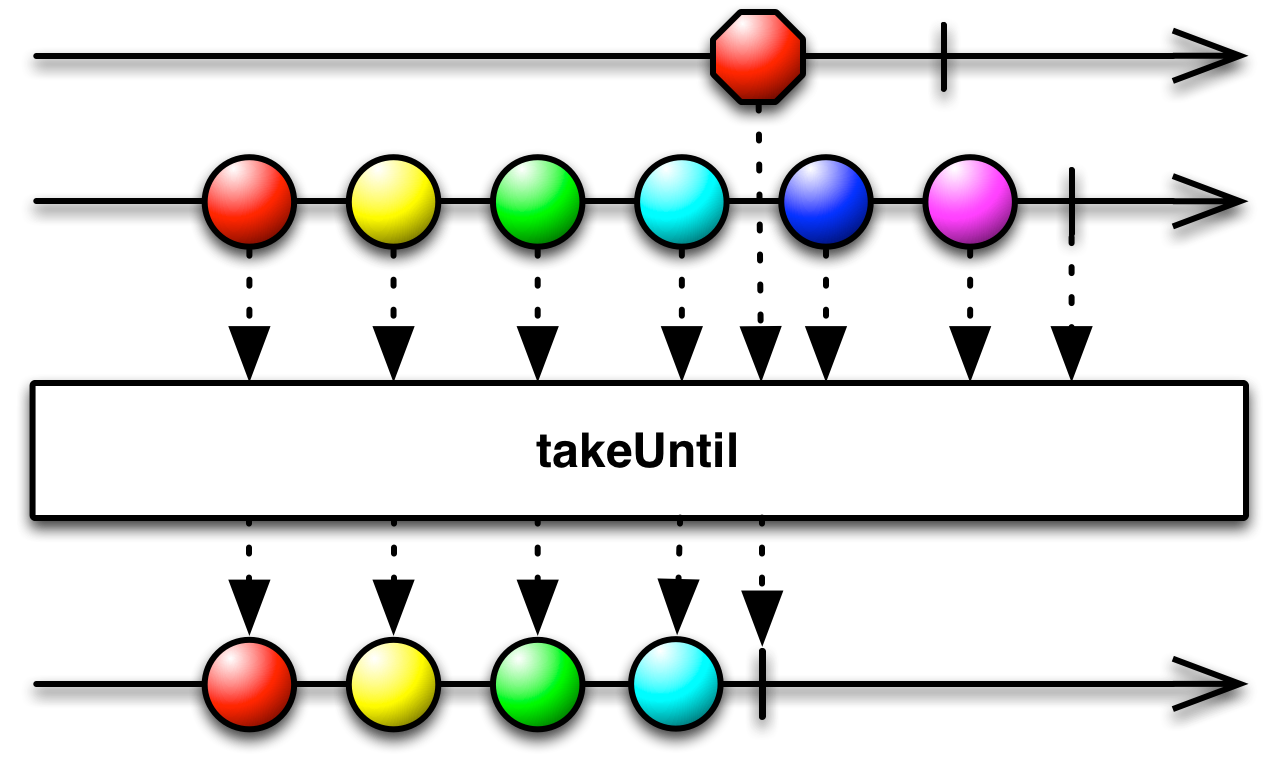
* You can combine items emitted by multiple Observables so that they act like a single * Observable, by using the {@code merge} method. * * @param source * a series of Observables * @return an Observable that emits items that are the result of flattening the items emitted * by the {@code source} Observables * @see MSDN: Observable.Merge Method */ public static Observable merge(Observable... source) { return create(OperationMerge.merge(source)); } /** * Returns an Observable that emits the items from the {@code source} Observable until * the {@code other} Observable emits an item. *

* * * @param source * the source Observable * @param other * the Observable whose first emitted item will cause {@code takeUntil} to stop * emitting items from the {@code source} Observable * @param * the type of items emitted by {@code source} * @param * the type of items emitted by {@code other} * @return an Observable that emits the items emitted by {@code source} until such time as * {@code other} emits its first item */ public static Observable takeUntil(final Observable source, final Observable other) { return OperationTakeUntil.takeUntil(source, other); } /** * Returns an Observable that emits the items emitted by two or more Observables, one after the * other. *
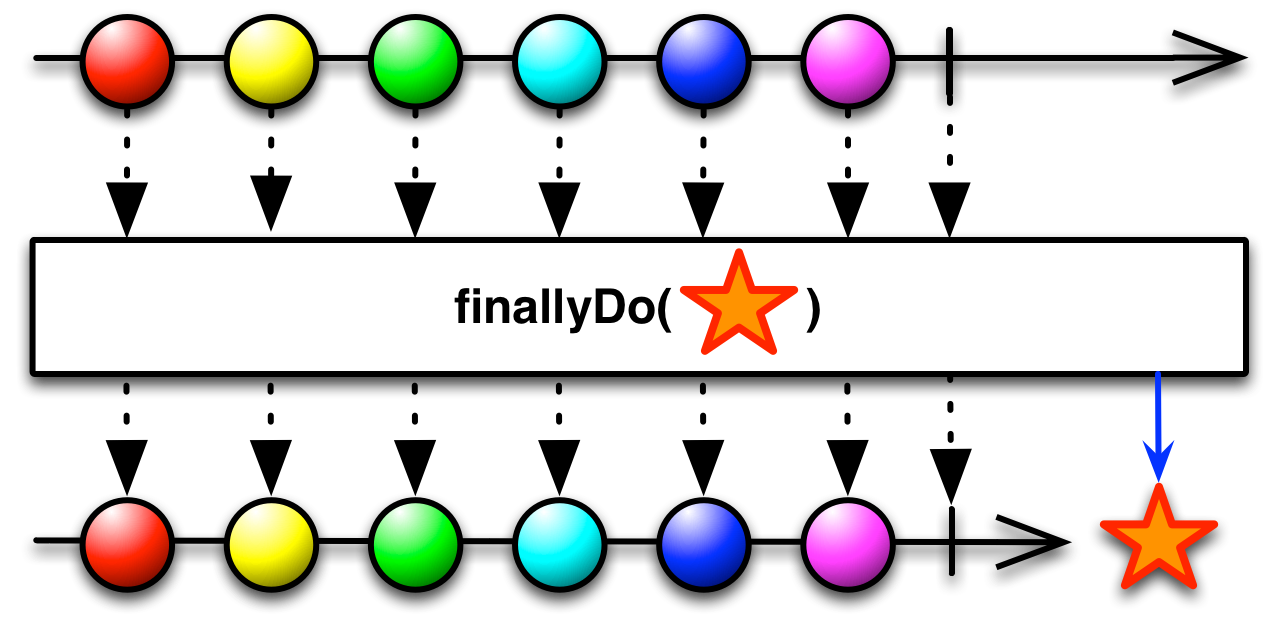
* * * @param source * a series of Observables * @return an Observable that emits items that are the result of combining the items emitted by * the {@code source} Observables, one after the other * @see MSDN: Observable.Concat Method */ public static Observable concat(Observable... source) { return create(OperationConcat.concat(source)); } /** * Returns an Observable that emits the same items as the source Observable, and then calls * the given Action after the Observable completes. *

* * * @param source * an Observable * @param action * an {@link Action0} to be invoked when the source Observable completes * or errors * @return an Observable that emits the same items as the source, then invokes the action * @see MSDN: * Observable.Finally Method */ public static Observable finallyDo(Observable source, Action0 action) { return create(OperationFinally.finallyDo(source, action)); } /** * Creates a new Observable by applying a function that you supply to each item emitted by * the source Observable, where that function returns an Observable, and then merging those * resulting Observables and emitting the results of this merger. *
* *
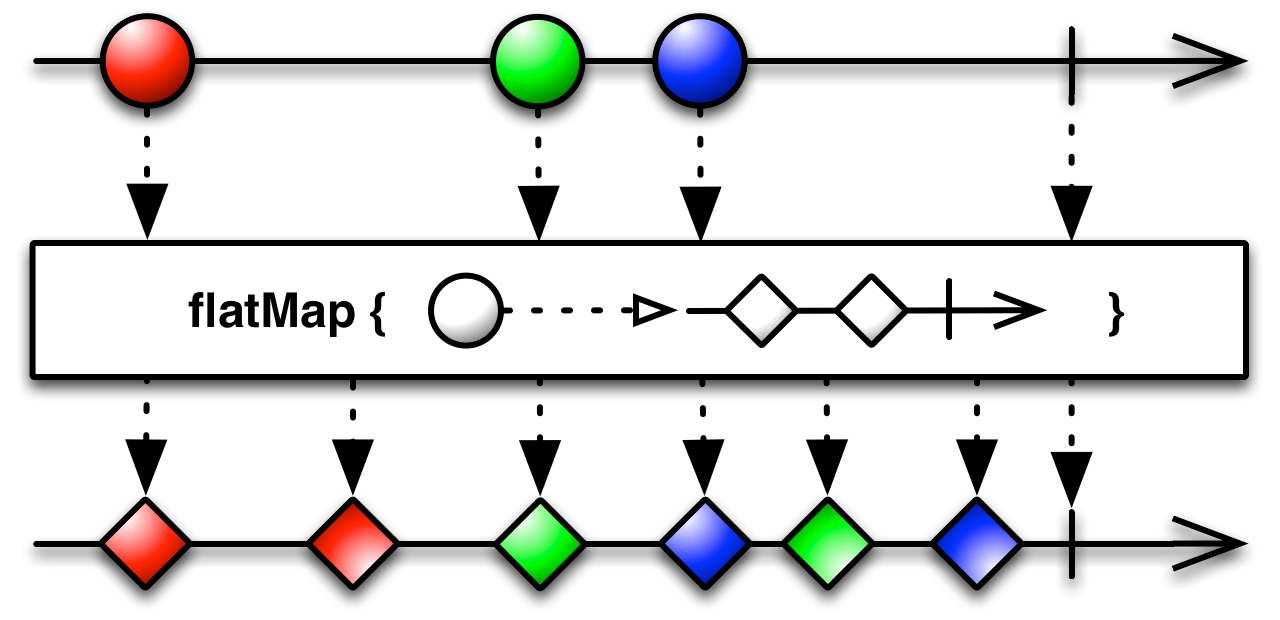
* Note: {@code mapMany} and {@code flatMap} are equivalent. * * @param sequence * the source Observable * @param func * a function that, when applied to each item emitted by the source Observable, * generates an Observable * @param * the type of items emitted by the source Observable * @param * the type of items emitted by the Observables that are returned from * {@code func} * @return an Observable that emits the result of applying the transformation function to each * item emitted by the source Observable and merging the results of the Observables * obtained from this transformation * @see #mapMany(Observable, Func1) */ public static Observable flatMap(Observable sequence, Func1> func) { return mapMany(sequence, func); } /** * Creates a new Observable by applying a function that you supply to each item emitted by * the source Observable, where that function returns an Observable, and then merging those * resulting Observables and emitting the results of this merger. *

* *

* Note: {@code mapMany} and {@code flatMap} are equivalent. * * @param sequence * the source Observable * @param func * a function that, when applied to each item emitted by the source Observable, * generates an Observable * @param * the type of items emitted by the source Observable * @param * the type of items emitted by the Observables that are returned from * {@code func} * @return an Observable that emits the result of applying the transformation function to each * item emitted by the source Observable and merging the results of the Observables * obtained from this transformation * @see #mapMany(Observable, Func1) */ public static Observable flatMap(Observable sequence, final Object func) { return mapMany(sequence, func); } /** * Groups the items emitted by an Observable according to a specified criterion, and emits these * grouped items as {@link GroupedObservable}s, one GroupedObservable per group. *

* * * @param source * an Observable whose items you want to group * @param keySelector * a function that extracts the key for each item omitted by the source Observable * @param elementSelector * a function to map each item emitted by the source Observable to an item emitted * by a {@link GroupedObservable} * @param * the key type * @param * the type of items emitted by the source Observable * @param * the type of items to be emitted by the resulting {@link GroupedObservable}s * @return an Observable that emits {@link GroupedObservable}s, each of which corresponds to a * unique key value and emits items representing items from the source Observable that * share that key value */ public static Observable> groupBy(Observable source, final Func1 keySelector, final Func1 elementSelector) { return create(OperationGroupBy.groupBy(source, keySelector, elementSelector)); } /** * Groups the items emitted by an Observable according to a specified criterion, and emits these * grouped items as {@link GroupedObservable}s, one GroupedObservable per group. *

* * * @param source * an Observable whose items you want to group * @param keySelector * a function that extracts the key for each item omitted by the source Observable * @param elementSelector * a function to map each item emitted by the source Observable to an item emitted * by a {@link GroupedObservable} * @param * the key type * @param * the type of items emitted by the source Observable * @param * the type of items to be emitted by the resulting {@link GroupedObservable}s * @return an Observable that emits {@link GroupedObservable}s, each of which corresponds to a * unique key value and emits items representing items from the source Observable that * share that key value */ @SuppressWarnings("rawtypes") public static Observable> groupBy(Observable source, final Object keySelector, final Object elementSelector) { final FuncN _k = Functions.from(keySelector); final FuncN _e = Functions.from(elementSelector); return groupBy(source, new Func1() { @SuppressWarnings("unchecked") @Override public K call(T t1) { return (K) _k.call(t1); } }, new Func1() { @SuppressWarnings("unchecked") @Override public R call(T t1) { return (R) _e.call(t1); } }); } /** * Groups the items emitted by an Observable according to a specified criterion, and emits these * grouped items as {@link GroupedObservable}s, one GroupedObservable per group. *

* * * @param source * an Observable whose items you want to group * @param keySelector * a function that extracts the key for each item emitted by the source Observable * @param * the key type * @param * the type of items to be emitted by the resulting {@link GroupedObservable}s * @return an Observable that emits {@link GroupedObservable}s, each of which corresponds to a * unique key value and emits items representing items from the source Observable that * share that key value */ public static Observable> groupBy(Observable source, final Func1 keySelector) { return create(OperationGroupBy.groupBy(source, keySelector)); } /** * Groups the items emitted by an Observable according to a specified criterion, and emits these * grouped items as {@link GroupedObservable}s, one GroupedObservable per group. *

* * * @param source * an Observable whose items you want to group * @param keySelector * a function that extracts the key for each item emitted by the source Observable * @param * the key type * @param * the type of items to be emitted by the resulting {@link GroupedObservable}s * @return an Observable that emits {@link GroupedObservable}s, each of which corresponds to a * unique key value and emits items representing items from the source Observable that * share that key value */ @SuppressWarnings("rawtypes") public static Observable> groupBy(Observable source, final Object keySelector) { final FuncN _k = Functions.from(keySelector); return groupBy(source, new Func1() { @SuppressWarnings("unchecked") @Override public K call(T t1) { return (K) _k.call(t1); } }); } /** * This behaves like {@link #merge(java.util.List)} except that if any of the merged Observables * notify of an error via {@link Observer#onError onError}, {@code mergeDelayError} will * refrain from propagating that error notification until all of the merged Observables have * finished emitting items. *

* *

* Even if multiple merged Observables send {@code onError} notifications, * {@code mergeDelayError} will only invoke the {@code onError} method of its * Observers once. *

* This method allows an Observer to receive all successfully emitted items from all of the * source Observables without being interrupted by an error notification from one of them. * * @param source * a list of Observables * @return an Observable that emits items that are the result of flattening the items emitted by * the {@code source} list of Observables * @see MSDN: Observable.Merge Method */ public static Observable mergeDelayError(List> source) { return create(OperationMergeDelayError.mergeDelayError(source)); } /** * This behaves like {@link #merge(Observable)} except that if any of the merged Observables * notify of an error via {@link Observer#onError onError}, {@code mergeDelayError} will * refrain from propagating that error notification until all of the merged Observables have * finished emitting items. *

* *

* Even if multiple merged Observables send {@code onError} notifications, * {@code mergeDelayError} will only invoke the {@code onError} method of its * Observers once. *

* This method allows an Observer to receive all successfully emitted items from all of the * source Observables without being interrupted by an error notification from one of them. * * @param source * an Observable that emits Observables * @return an Observable that emits items that are the result of flattening the items emitted by * the Observables emitted by the {@code source} Observable * @see MSDN: Observable.Merge Method */ public static Observable mergeDelayError(Observable> source) { return create(OperationMergeDelayError.mergeDelayError(source)); } /** * This behaves like {@link #merge(Observable...)} except that if any of the merged Observables * notify of an error via {@link Observer#onError onError}, {@code mergeDelayError} will * refrain from propagating that error notification until all of the merged Observables have * finished emitting items. *

* *

* Even if multiple merged Observables send {@code onError} notifications, * {@code mergeDelayError} will only invoke the {@code onError} method of its * Observers once. *

* This method allows an Observer to receive all successfully emitted items from all of the * source Observables without being interrupted by an error notification from one of them. * * @param source * a series of Observables * @return an Observable that emits items that are the result of flattening the items emitted by * the {@code source} Observables * @see MSDN: Observable.Merge Method */ public static Observable mergeDelayError(Observable... source) { return create(OperationMergeDelayError.mergeDelayError(source)); } /** * Returns an Observable that never sends any items or notifications to an {@link Observer}. *

* *

* This Observable is useful primarily for testing purposes. * * @param * the type of items (not) emitted by the Observable * @return an Observable that never sends any items or notifications to an {@link Observer} */ public static Observable never() { return new NeverObservable(); } /** * Instruct an Observable to pass control to another Observable (the return value of a function) * rather than invoking {@link Observer#onError onError} if it encounters an error. *

* *

* By default, when an Observable encounters an error that prevents it from emitting the * expected item to its Observer, the Observable invokes its {@link Observer}'s * {@code onError} method, and then quits without invoking any more of its Observer's * methods. The {@code onErrorResumeNext} method changes this behavior. If you pass a * function that returns an Observable ({@code resumeFunction}) to * {@code onErrorResumeNext}, if the source Observable encounters an error, instead of * invoking its Observer's {@code onError} function, it will instead relinquish control to * this new Observable, which will invoke the Observer's {@link Observer#onNext onNext} method * if it is able to do so. In such a case, because no Observable necessarily invokes * {@code onError}, the Observer may never know that an error happened. *

* You can use this to prevent errors from propagating or to supply fallback data should errors * be encountered. * * @param that * the source Observable * @param resumeFunction * a function that returns an Observable that will take over if the source Observable * encounters an error * @return an Observable, identical to the source Observable with its behavior modified as described */ public static Observable onErrorResumeNext(final Observable that, final Func1> resumeFunction) { return create(OperationOnErrorResumeNextViaFunction.onErrorResumeNextViaFunction(that, resumeFunction)); } /** * Instruct an Observable to pass control to another Observable (the return value of a function) * rather than invoking {@link Observer#onError onError} if it encounters an error. *

* *

* By default, when an Observable encounters an error that prevents it from emitting the * expected item to its Observer, the Observable invokes its {@link Observer}'s * methods. The {@code onErrorResumeNext} method changes this behavior. If you pass a * function that returns an Observable ({@code resumeFunction}) to * {@code onErrorResumeNext}, if the source Observable encounters an error, instead of * invoking its Observer's {@code onError} function, it will instead relinquish control to * this new Observable, which will invoke the Observer's {@link Observer#onNext onNext} method * if it is able to do so. In such a case, because no Observable necessarily invokes * {@code onError}, the Observer may never know that an error happened. *

* You can use this to prevent errors from propagating or to supply fallback data should errors * be encountered. * * @param that * the source Observable * @param resumeFunction * a function that returns an Observable that will take over if the source Observable * encounters an error * @return an Observable, identical to the source Observable with its behavior modified as described */ public static Observable onErrorResumeNext(final Observable that, final Object resumeFunction) { @SuppressWarnings("rawtypes") final FuncN _f = Functions.from(resumeFunction); return onErrorResumeNext(that, new Func1>() { @SuppressWarnings("unchecked") @Override public Observable call(Throwable e) { return (Observable) _f.call(e); } }); } /** * Instruct an Observable to pass control to another Observable rather than invoking * {@link Observer#onError onError} if it encounters an error. *

* *

* By default, when an Observable encounters an error that prevents it from emitting the * expected item to its Observer, the Observable invokes its {@link Observer}'s * {@code onError} method, and then quits without invoking any more of its Observer's * methods. The {@code onErrorResumeNext} method changes this behavior. If you pass an * Observable ({@code resumeSequence}) to {@code onErrorResumeNext}, if the original * Observable encounters an error, instead of invoking its Observer's onError * method, it will instead relinquish control to this new Observable, which will invoke the * Observer's {@link Observer#onNext onNext} method if it is able to do so. In such a case, * because no Observable necessarily invokes {@code onError}, the Observer may never know * that an error happened. *

* You can use this to prevent errors from propagating or to supply fallback data should errors * be encountered. * * @param that * the source Observable * @param resumeSequence * a Observable that will take over if the source Observable encounters an error * @return an Observable, identical to the source Observable with its behavior modified as described */ public static Observable onErrorResumeNext(final Observable that, final Observable resumeSequence) { return create(OperationOnErrorResumeNextViaObservable.onErrorResumeNextViaObservable(that, resumeSequence)); } /** * Instruct an Observable to emit a particular item to its Observer's {@code onNext} * function rather than invoking {@link Observer#onError onError} if it encounters an error. *

* *

* By default, when an Observable encounters an error that prevents it from emitting the * expected item to its {@link Observer}, the Observable invokes its Observer's * {@code onError} method, and then quits without invoking any more of its Observer's * methods. The {@code onErrorReturn} method changes this behavior. If you pass a function * ({@code resumeFunction}) to {@code onErrorReturn}, if the source Observable * encounters an error, instead of invoking its Observer's {@code onError} method, it will * instead pass the return value of {@code resumeFunction} to the Observer's * {@link Observer#onNext onNext} method. *

* You can use this to prevent errors from propagating or to supply fallback data should errors * be encountered. * * @param that * the source Observable * @param resumeFunction * a function that returns an item that will be passed into an {@link Observer}'s * {@link Observer#onNext onNext} method if the Observable encounters an error that * would otherwise cause it to invoke {@link Observer#onError onError} * @return an Observable, identical to the source Observable with its behavior modified as described */ public static Observable onErrorReturn(final Observable that, Func1 resumeFunction) { return create(OperationOnErrorReturn.onErrorReturn(that, resumeFunction)); } /** * Instruct an Observable to pass control to another Observable rather than invoking {@link Observer#onError onError} if it encounters an error of type {@link java.lang.Exception}. *

* This differs from {@link #onErrorResumeNext} in that this one does not handle {@link java.lang.Throwable} or {@link java.lang.Error} but lets those continue through. *

* *

* By default, when an Observable encounters an error that prevents it from emitting the * expected item to its Observer, the Observable invokes its {@link Observer}'s {@code onError} method, and then quits without invoking any more of its Observer's * methods. The {@code onErrorResumeNext} method changes this behavior. If you pass an * Observable ({@code resumeSequence}) to {@code onErrorResumeNext}, if the original * Observable encounters an error, instead of invoking its Observer's onError * method, it will instead relinquish control to this new Observable, which will invoke the * Observer's {@link Observer#onNext onNext} method if it is able to do so. In such a case, * because no Observable necessarily invokes {@code onError}, the Observer may never know * that an error happened. *

* You can use this to prevent errors from propagating or to supply fallback data should errors * be encountered. * * @param that * the source Observable * @param resumeSequence * a Observable that will take over if the source Observable encounters an error * @return an Observable, identical to the source Observable with its behavior modified as described */ public static Observable onExceptionResumeNext(final Observable that, final Observable resumeSequence) { return create(OperationOnExceptionResumeNextViaObservable.onExceptionResumeNextViaObservable(that, resumeSequence)); } /** * Returns a {@link ConnectableObservable} that shares a single subscription to the underlying * Observable that will replay all of its items and notifications to any future * {@link Observer}. *

* * @param that * the source Observable * @return a {@link ConnectableObservable} that upon connection causes the source Observable to * emit items to its {@link Observer}s */ public static ConnectableObservable replay(final Observable that) { return OperationMulticast.multicast(that, ReplaySubject. create()); } /** * This method has similar behavior to {@link #replay} except that this auto-subscribes to * the source Observable rather than returning a {@link ConnectableObservable}. *

* *

* This is useful when you want an Observable to cache responses and you can't control the * subscribe/unsubscribe behavior of all the {@link Observer}s. *

* NOTE: You sacrifice the ability to unsubscribe from the origin when you use the * cache() operator so be careful not to use this operator on Observables that * emit an infinite or very large number of items that will use up memory. * * @return an Observable that when first subscribed to, caches all of the items and * notifications it emits so it can replay them for subsequent subscribers. */ public static Observable cache(final Observable that) { return create(OperationCache.cache(that)); } /** * Returns a {@link ConnectableObservable}, which waits until its * {@link ConnectableObservable#connect} method is called before it begins emitting items to * those {@link Observer}s that have subscribed to it. *

* * * @param that * the source Observable * @return a {@link ConnectableObservable} that upon connection causes the source Observable to * emit items to its {@link Observer} */ public static ConnectableObservable publish(final Observable that) { return OperationMulticast.multicast(that, PublishSubject. create()); } /** * Returns an Observable that applies a function of your choosing to the first item emitted by a * source Observable, then feeds the result of that function along with the second item emitted * by the source Observable into the same function, and so on until all items have been emitted * by the source Observable, and emits the final result from the final call to your function as * its sole item. *

* *

* This technique, which is called "reduce" or "aggregate" here, is sometimes called "fold," * "accumulate," "compress," or "inject" in other programming contexts. Groovy, for instance, * has an {@code inject} method that does a similar operation on lists. * * @param * the type of item emitted by the source Observable * @param sequence * the source Observable * @param accumulator * an accumulator function to be invoked on each item emitted by the source * Observable, the result of which will be used in the next accumulator call * @return an Observable that emits a single item that is the result of applying the * accumulator function to the sequence of items emitted by the source Observable * @see MSDN: Observable.Aggregate * @see Wikipedia: Fold (higher-order function) */ public static Observable reduce(Observable sequence, Func2 accumulator) { return takeLast(create(OperationScan.scan(sequence, accumulator)), 1); } /** * A version of {@code reduce()} for use by dynamic languages. *

* * * @see #reduce(Observable, Func2) */ public static Observable reduce(final Observable sequence, final Object accumulator) { @SuppressWarnings("rawtypes") final FuncN _f = Functions.from(accumulator); return reduce(sequence, new Func2() { @SuppressWarnings("unchecked") @Override public T call(T t1, T t2) { return (T) _f.call(t1, t2); } }); } /** * Synonymous with {@code reduce()} *

* * * @see #reduce(Observable, Func2) */ public static Observable aggregate(Observable sequence, Func2 accumulator) { return reduce(sequence, accumulator); } /** * A version of {@code aggregate()} for use by dynamic languages. *

* * * @see #reduce(Observable, Func2) */ public static Observable aggregate(Observable sequence, Object accumulator) { return reduce(sequence, accumulator); } /** * Returns an Observable that applies a function of your choosing to the first item emitted by a * source Observable, then feeds the result of that function along with the second item emitted * by the source Observable into the same function, and so on until all items have been emitted * by the source Observable, emitting the final result from the final call to your function as * its sole item. *

* *

* This technique, which is called "reduce" or "aggregate" here, is sometimes called "fold," * "accumulate," "compress," or "inject" in other programming contexts. Groovy, for instance, * has an {@code inject} method that does a similar operation on lists. * * @param * the type of item emitted by the source Observable * @param * the type returned by the accumulator function, and the type of the seed * @param sequence * the source Observable * @param initialValue * a seed to pass in to the first execution of the accumulator function * @param accumulator * an accumulator function to be invoked on each item emitted by the source * Observable, the result of which will be used in the next accumulator call * @return an Observable that emits a single item that is the result of applying the * accumulator function to the sequence of items emitted by the source Observable * @see MSDN: Observable.Aggregate * @see Wikipedia: Fold (higher-order function) */ public static Observable reduce(Observable sequence, R initialValue, Func2 accumulator) { return takeLast(create(OperationScan.scan(sequence, initialValue, accumulator)), 1); } /** * A version of {@code reduce()} for use by dynamic languages. *

* * * @see #reduce(Observable, Object, Func2) */ public static Observable reduce(final Observable sequence, final R initialValue, final Object accumulator) { @SuppressWarnings("rawtypes") final FuncN _f = Functions.from(accumulator); return reduce(sequence, initialValue, new Func2() { @SuppressWarnings("unchecked") @Override public R call(R r, T t) { return (R) _f.call(r, t); } }); } /** * Synonymous with {@code reduce()}. *

* * * @see #reduce(Observable, Object, Func2) */ public static Observable aggregate(Observable sequence, R initialValue, Func2 accumulator) { return reduce(sequence, initialValue, accumulator); } /** * A version of {@code aggregate()} for use by dynamic languages. *

* * * @see #reduce(Observable, Object, Func2) */ public static Observable aggregate(Observable sequence, R initialValue, Object accumulator) { return reduce(sequence, initialValue, accumulator); } /** * Returns an Observable that applies a function of your choosing to the first item emitted by a * source Observable, then feeds the result of that function along with the second item emitted * by the source Observable into the same function, and so on until all items have been emitted * by the source Observable, emitting the result of each of these iterations. *

* * * @param * the type of item emitted by the source Observable * @param sequence * the source Observable * @param accumulator * an accumulator function to be invoked on each item emitted by the source * Observable, the result of which will be emitted and used in the next accumulator * call * @return an Observable that emits items that are the result of accumulating the items from * the source Observable * @see MSDN: Observable.Scan */ public static Observable scan(Observable sequence, Func2 accumulator) { return create(OperationScan.scan(sequence, accumulator)); } /** * A version of {@code scan()} for use by dynamic languages. *

* * * @see #scan(Observable, Func2) */ public static Observable scan(final Observable sequence, final Object accumulator) { @SuppressWarnings("rawtypes") final FuncN _f = Functions.from(accumulator); return scan(sequence, new Func2() { @SuppressWarnings("unchecked") @Override public T call(T t1, T t2) { return (T) _f.call(t1, t2); } }); } /** * Returns an Observable that applies a function of your choosing to the first item emitted by a * source Observable, then feeds the result of that function along with the second item emitted * by the source Observable into the same function, and so on until all items have been emitted * by the source Observable, emitting the result of each of these iterations. *

* *

* Note that when you pass a seed to {@code scan()}, that seed will be the first item * emitted by the resulting Observable. * * @param * the type of item emitted by the source Observable * @param * the type returned by the accumulator function, and the type of the seed * @param sequence * the source Observable * @param initialValue * the initial (seed) accumulator value * @param accumulator * an accumulator function to be invoked on each item emitted by the source * Observable, the result of which will be emitted and used in the next accumulator * call * @return an Observable that emits items that are the result of accumulating the items emitted * by the source Observable * @see MSDN: Observable.Scan */ public static Observable scan(Observable sequence, R initialValue, Func2 accumulator) { return create(OperationScan.scan(sequence, initialValue, accumulator)); } /** * A version of {@code scan()} for use by dynamic languages. *

* * * @see #scan(Observable, Object, Func2) */ public static Observable scan(final Observable sequence, final R initialValue, final Object accumulator) { @SuppressWarnings("rawtypes") final FuncN _f = Functions.from(accumulator); return scan(sequence, initialValue, new Func2() { @SuppressWarnings("unchecked") @Override public R call(R r, T t) { return (R) _f.call(r, t); } }); } /** * Returns an Observable that emits a single Boolean value that indicates whether all items emitted by a * source Observable satisfy a condition. *

* * * @param sequence * an Observable whose emitted items you are evaluating * @param predicate * a function that evaluates each emitted item and returns a Boolean * @param * the type of items emitted by the source Observable * @return an Observable that emits {@code true} if all of the items emitted by the source * Observable satisfy the predicate; otherwise, {@code false} */ public static Observable all(final Observable sequence, final Func1 predicate) { return create(OperationAll.all(sequence, predicate)); } /** * Returns an Observable that emits a single Boolean value that indicates whether all items emitted by a * source Observable satisfy a condition. *

* * * @param sequence * an Observable whose emitted items you are evaluating * @param predicate * a function that evaluates each emitted item and returns a Boolean * @param * the type of items emitted by the source Observable * @return an Observable that emits {@code true} if all items emitted by the source * Observable satisfy the predicate; otherwise, {@code false} */ public static Observable all(final Observable sequence, Object predicate) { @SuppressWarnings("rawtypes") final FuncN _f = Functions.from(predicate); return all(sequence, new Func1() { @Override public Boolean call(T t) { return (Boolean) _f.call(t); } }); } /** * Returns an Observable that skips the first {@code num} items emitted by the source * Observable and emits the remaining items. *

* *

* You can ignore the first {@code num} items emitted by an Observable and attend only to * those items that come after, by modifying the Observable with the {@code skip} method. * * @param items * the source Observable * @param num * the number of items to skip * @return an Observable that emits the same items emitted by the source Observable, except for * the first {@code num} items * @see MSDN: Observable.Skip Method */ public static Observable skip(final Observable items, int num) { return create(OperationSkip.skip(items, num)); } /** * Given an Observable that emits Observables, creates a single Observable that * emits the items emitted by the most recently published of those Observables. *

* * * @param sequenceOfSequences * the source Observable that emits Observables * @return an Observable that emits only the items emitted by the most recently published * Observable */ public static Observable switchDo(Observable> sequenceOfSequences) { return create(OperationSwitch.switchDo(sequenceOfSequences)); } /** * Accepts an Observable and wraps it in another Observable that ensures that the resulting * Observable is chronologically well-behaved. *

* *

* A well-behaved Observable does not interleave its invocations of the * {@link Observer#onNext onNext}, {@link Observer#onCompleted onCompleted}, and * {@link Observer#onError onError} methods of its {@link Observer}s; it invokes * {@code onCompleted} or {@code onError} only once; and it never invokes * {@code onNext} after invoking either {@code onCompleted} or {@code onError}. * {@code synchronize} enforces this, and the Observable it returns invokes * {@code onNext} and {@code onCompleted} or {@code onError} synchronously. * * @param observable * the source Observable * @param * the type of item emitted by the source Observable * @return an Observable that is a chronologically well-behaved version of the source * Observable, and that synchronously notifies its {@link Observer}s */ public static Observable synchronize(Observable observable) { return create(OperationSynchronize.synchronize(observable)); } /** * Returns an Observable that emits the first {@code num} items emitted by the source * Observable. *

* *

* This method returns an Observable that will invoke a subscribing {@link Observer}'s * {@link Observer#onNext onNext} method a maximum of {@code num} times before invoking * {@link Observer#onCompleted onCompleted}. * * @param items * the source Observable * @param num * the number of items to emit from the start of the sequence emitted by the source * Observable * @return an Observable that emits only the first {@code num} items emitted by the source * Observable */ public static Observable take(final Observable items, final int num) { return create(OperationTake.take(items, num)); } /** * Returns an Observable that emits the last {@code count} items emitted by the source * Observable. *

* * * @param items * the source Observable * @param count * the number of items to emit from the end of the sequence emitted by the source * Observable * @return an Observable that emits only the last count items emitted by the source * Observable */ public static Observable takeLast(final Observable items, final int count) { return create(OperationTakeLast.takeLast(items, count)); } /** * Returns an Observable that emits the items emitted by a source Observable so long as a given * predicate, operating on the items emitted, remains true. *

* * * @param items * the source Observable * @param predicate * a function to test each item emitted by the source Observable for a condition * @return an Observable that emits items from the source Observable so long as the predicate * continues to return {@code true} for each item, then completes */ public static Observable takeWhile(final Observable items, Func1 predicate) { return create(OperationTakeWhile.takeWhile(items, predicate)); } /** * Returns an Observable that emits the items emitted by a source Observable so long as a given * predicate, operating on the items emitted, remains true. *

* * * @param items * the source Observable * @param predicate * a function to test each item emitted by the source Observable for a condition * @return an Observable that emits items from the source Observable so long as the predicate * continues to return {@code true} for each item, then completes */ public static Observable takeWhile(final Observable items, Object predicate) { @SuppressWarnings("rawtypes") final FuncN _f = Functions.from(predicate); return takeWhile(items, new Func1() { @Override public Boolean call(T t) { return (Boolean) _f.call(t); } }); } /** * Returns an Observable that emits the items emitted by a source Observable so long as a given * predicate remains true, where the predicate can operate on both the item and its index * relative to the complete sequence. *

* * * @param items * the source Observable * @param predicate * a function to test each item emitted by the source Observable for a condition; * the second parameter of the function represents the index of the source item * @return an Observable that emits items from the source Observable so long as the predicate * continues to return {@code true} for each item, then completes */ public static Observable takeWhileWithIndex(final Observable items, Func2 predicate) { return create(OperationTakeWhile.takeWhileWithIndex(items, predicate)); } /** * Returns an Observable that emits the items emitted by a source Observable so long as a given * predicate remains true, where the predicate can operate on both the item and its index * relative to the complete sequence. *

* * * @param items * the source Observable * @param predicate * a function to test each item emitted by the source Observable for a condition; * the second parameter of the function represents the index of the source item * @return an Observable that emits items from the source Observable so long as the predicate * continues to return {@code true} for each item, then completes */ public static Observable takeWhileWithIndex(final Observable items, Object predicate) { @SuppressWarnings("rawtypes") final FuncN _f = Functions.from(predicate); return create(OperationTakeWhile.takeWhileWithIndex(items, new Func2() { @Override public Boolean call(T t, Integer integer) { return (Boolean) _f.call(t, integer); } })); } /** * Wraps each item emitted by a source Observable in a {@link Timestamped} object. *

* * * @return an Observable that emits timestamped items from the source Observable */ public Observable> timestamp() { return create(OperationTimestamp.timestamp(this)); } /** * Returns an Observable that emits a single item, a list composed of all the items emitted by * the source Observable. *

* *

* Normally, an Observable that emits multiple items will do so by invoking its * {@link Observer}'s {@link Observer#onNext onNext} method once for each such item. {@code toList} * allows you can change this behavior, instructing the Observable to compose a List of all of the * items and then invoke the Observer's {@code onNext} function once, passing the entire list. *

* Be careful not to use this operator on Observables that emit an infinite or very large * number of items, as all items will be held in memory and you do not have the option to * unsubscribe. * * @param that * the source Observable * @return an Observable that emits a single item: a {@code List} containing all of the * items emitted by the source Observable */ public static Observable> toList(final Observable that) { return create(OperationToObservableList.toObservableList(that)); } /** * Returns a {@link ConnectableObservable} that upon connection causes the source Observable to * emit items into the specified {@link Subject}. * * @param source * the source Observable whose emitted items will be pushed into the specified * {@link Subject} * @param subject * the {@link Subject} to push source items into * @param * the type of items emitted by the source Observable * @param * the type of the {@link Subject} * @return a {@link ConnectableObservable} that upon connection causes the source Observable to * push items into the specified {@link Subject} */ public static ConnectableObservable multicast(Observable source, final Subject subject) { return OperationMulticast.multicast(source, subject); } /** * Converts an {@link Iterable} sequence into an Observable. *

* *

* You can convert any object that supports the Iterable interface into an Observable that * emits each item in the Iterable, by passing the Iterable into the toObservable * method. * * @param iterable * the source {@link Iterable} sequence * @param * the type of items in the {@link Iterable} sequence and the type of items to be * emitted by the resulting Observable * @return an Observable that emits each item in the source {@link Iterable} sequence */ public static Observable toObservable(Iterable iterable) { return create(OperationToObservableIterable.toObservableIterable(iterable)); } /** * Converts a {@link Future} into an Observable. * *

* *

* Important note: This Observable is blocking; you cannot unsubscribe from it. * * @param future * the source {@link Future} * @param * the type of of object that the {@link Future} returns, and also the type of the * item emitted by the resulting Observable * @return an Observable that emits the item from the source {@link Future} * @deprecated Replaced by {@link #from(Future)} */ public static Observable toObservable(Future future) { return create(OperationToObservableFuture.toObservableFuture(future)); } /** * Converts a {@link Future} into an Observable. *

* *

* You can convert any object that supports the {@link Future} interface into an Observable that * emits the return value of the {@link Future#get} method of that object, by passing the * object into the {@code from} method. *

* Important note: This Observable is blocking; you cannot unsubscribe from it. * * @param future * the source {@link Future} * @param * the type of object that the {@link Future} returns, and also the type of item to * be emitted by the resulting Observable * @return an Observable that emits the item from the source Future */ public static Observable from(Future future) { return create(OperationToObservableFuture.toObservableFuture(future)); } /** * Converts a {@link Future} into an Observable with timeout. *

* Important note: This Observable is blocking; you cannot unsubscribe from it. * * @param future * the source {@link Future} * @param timeout * the maximum time to wait * @param unit * the {@link TimeUnit} of the time argument * @param * the type of object that the {@link Future} returns, and also the type of item to * be emitted by the resulting Observable * @return an Observable that emits the item from the source {@link Future} * @deprecated Replaced by {@link #from(Future, long, TimeUnit)} */ public static Observable toObservable(Future future, long timeout, TimeUnit unit) { return create(OperationToObservableFuture.toObservableFuture(future, timeout, unit)); } /** * Converts a {@link Future} into an Observable with timeout. *

* *

* You can convert any object that supports the {@link Future} interface into an Observable that * emits the return value of the {link Future#get} method of that object, by passing the * object into the {@code from} method. *

* Important note: This Observable is blocking; you cannot unsubscribe from it. * * @param future * the source {@link Future} * @param timeout * the maximum time to wait before calling get() * @param unit * the {@link TimeUnit} of the time argument * @param * the type of object that the {@link Future} returns, and also the type of item to * be emitted by the resulting Observable * @return an Observable that emits the item from the source {@link Future} */ public static Observable from(Future future, long timeout, TimeUnit unit) { return create(OperationToObservableFuture.toObservableFuture(future, timeout, unit)); } /** * Converts an array sequence into an Observable. * * @param items * the source array * @param * the type of items in the array, and also the type of items emitted by the * resulting Observable * @return an Observable that emits each item in the source array * @deprecated Use {@link #from(Object...)} */ public static Observable toObservable(T... items) { return toObservable(Arrays.asList(items)); } /** * Return an Observable that emits a single list of the items emitted by the source Observable, in sorted * order (each item emitted by the source Observable must implement {@link Comparable} with * respect to all other items emitted by the source Observable). *

* * * @param sequence * the source Observable * @throws ClassCastException * if any emitted item does not implement {@link Comparable} with respect to all * other emitted items * @return an Observable that emits a single,sorted list of the items from the source Observable */ public static Observable> toSortedList(Observable sequence) { return create(OperationToObservableSortedList.toSortedList(sequence)); } /** * Return an Observable that emits a single list of the items emitted by the source Observable, sorted * by the given comparison function. *

* * * @param sequence * the source Observable * @param sortFunction * a function that compares two items emitted by the source Observable and returns * an Integer that indicates their sort order * @return an Observable that emits a single, sorted list of the items from the source Observable */ public static Observable> toSortedList(Observable sequence, Func2 sortFunction) { return create(OperationToObservableSortedList.toSortedList(sequence, sortFunction)); } /** * Return an Observable that emits a single list of the items emitted by the source Observable, sorted * by the given comparison function. *

* * * @param sequence * the source Observable * @param sortFunction * a function that compares two items emitted by the source Observable and returns * an Integer that indicates their sort order * @return an Observable that emits a single, sorted list of the items from the source Observable */ public static Observable> toSortedList(Observable sequence, final Object sortFunction) { @SuppressWarnings("rawtypes") final FuncN _f = Functions.from(sortFunction); return create(OperationToObservableSortedList.toSortedList(sequence, new Func2() { @Override public Integer call(T t1, T t2) { return (Integer) _f.call(t1, t2); } })); } /** * Returns an Observable that emits the results of a function of your choosing applied to pairs * of items emitted, in sequence, by two other Observables. *

* *

* {@code zip} applies this function in strict sequence, so the first item emitted by the * new Observable will be the result of the function applied to the first item emitted by * {@code w0} and the first item emitted by {@code w1}; the second item emitted by * the new Observable will be the result of the function applied to the second item emitted by * {@code w0} and the second item emitted by {@code w1}; and so forth. *

* The resulting {@code Observable} returned from {@code zip} will invoke * {@link Observer#onNext onNext} as many times as the number of {@code onNext} invocations * of the source Observable that emits the fewest items. * * @param w0 * one source Observable * @param w1 * another source Observable * @param reduceFunction * a function that, when applied to a pair of items, each emitted by one of the two * source Observables, results in an item that will be emitted by the resulting * Observable * @return an Observable that emits the zipped results */ public static Observable zip(Observable w0, Observable w1, Func2 reduceFunction) { return create(OperationZip.zip(w0, w1, reduceFunction)); } /** * Returns an Observable that emits Boolean values that indicate whether the pairs of items * emitted by two source Observables are equal. *

* * * @param first * one Observable to compare * @param second * the second Observable to compare * @param * the type of items emitted by each Observable * @return an Observable that emits Booleans that indicate whether the corresponding items * emitted by the source Observables are equal */ public static Observable sequenceEqual(Observable first, Observable second) { return sequenceEqual(first, second, new Func2() { @Override public Boolean call(T first, T second) { return first.equals(second); } }); } /** * Returns an Observable that emits Boolean values that indicate whether the pairs of items * emitted by two source Observables are equal based on the results of a specified equality * function. *

* * * @param first * one Observable to compare * @param second * the second Observable to compare * @param equality * a function used to compare items emitted by both Observables * @param * the type of items emitted by each Observable * @return an Observable that emits Booleans that indicate whether the corresponding items * emitted by the source Observables are equal */ public static Observable sequenceEqual(Observable first, Observable second, Func2 equality) { return zip(first, second, equality); } /** * Returns an Observable that emits Boolean values that indicate whether the pairs of items * emitted by two source Observables are equal based on the results of a specified equality * function. *

* * * @param first * one Observable to compare * @param second * the second Observable to compare * @param equality * a function used to compare items emitted by both Observables * @param * the type of items emitted by each Observable * @return an Observable that emits Booleans that indicate whether the corresponding items * emitted by the source Observables are equal */ public static Observable sequenceEqual(Observable first, Observable second, Object equality) { return zip(first, second, equality); } /** * Returns an Observable that emits the results of a function of your choosing applied to pairs * of items emitted, in sequence, by two other Observables. *

* *

* zip applies this function in strict sequence, so the first item emitted by the * new Observable will be the result of the function applied to the first item emitted by * w0 and the first item emitted by w1; the second item emitted by * the new Observable will be the result of the function applied to the second item emitted by * w0 and the second item emitted by w1; and so forth. *

* The resulting Observable<R> returned from zip will invoke * {@link Observer#onNext onNext} as many times as the number of onNext invocations * of the source Observable that emits the fewest items. * * @param w0 * one source Observable * @param w1 * another source Observable * @param function * a function that, when applied to a pair of items, each emitted by one of the two * source Observables, results in an item that will be emitted by the resulting * Observable * @return an Observable that emits the zipped results */ public static Observable zip(Observable w0, Observable w1, final Object function) { @SuppressWarnings("rawtypes") final FuncN _f = Functions.from(function); return zip(w0, w1, new Func2() { @SuppressWarnings("unchecked") @Override public R call(T0 t0, T1 t1) { return (R) _f.call(t0, t1); } }); } /** * Returns an Observable that emits the results of a function of your choosing applied to * combinations of three items emitted, in sequence, by three other Observables. *

* *

* {@code zip} applies this function in strict sequence, so the first item emitted by the * new Observable will be the result of the function applied to the first item emitted by * {@code w0}, the first item emitted by {@code w1}, and the first item emitted by * {@code w2}; the second item emitted by the new Observable will be the result of the * function applied to the second item emitted by {@code w0}, the second item emitted by * {@code w1}, and the second item emitted by {@code w2}; and so forth. *

* The resulting {@code Observable} returned from {@code zip} will invoke * {@link Observer#onNext onNext} as many times as the number of {@code onNext} invocations * of the source Observable that emits the fewest items. * * @param w0 * one source Observable * @param w1 * another source Observable * @param w2 * a third source Observable * @param function * a function that, when applied to an item emitted by each of the source * Observables, results in an item that will be emitted by the resulting Observable * @return an Observable that emits the zipped results */ public static Observable zip(Observable w0, Observable w1, Observable w2, Func3 function) { return create(OperationZip.zip(w0, w1, w2, function)); } /** * Returns an Observable that emits the results of a function of your choosing applied to * combinations of three items emitted, in sequence, by three other Observables. *

* *

* zip applies this function in strict sequence, so the first item emitted by the * new Observable will be the result of the function applied to the first item emitted by * w0, the first item emitted by w1, and the first item emitted by * w2; the second item emitted by the new Observable will be the result of the * function applied to the second item emitted by w0, the second item emitted by * w1, and the second item emitted by w2; and so forth. *

* The resulting Observable<R> returned from zip will invoke * {@link Observer#onNext onNext} as many times as the number of onNext invocations * of the source Observable that emits the fewest items. * * @param w0 * one source Observable * @param w1 * another source Observable * @param w2 * a third source Observable * @param function * a function that, when applied to an item emitted by each of the source * Observables, results in an item that will be emitted by the resulting Observable * @return an Observable that emits the zipped results */ public static Observable zip(Observable w0, Observable w1, Observable w2, final Object function) { @SuppressWarnings("rawtypes") final FuncN _f = Functions.from(function); return zip(w0, w1, w2, new Func3() { @SuppressWarnings("unchecked") @Override public R call(T0 t0, T1 t1, T2 t2) { return (R) _f.call(t0, t1, t2); } }); } /** * Returns an Observable that emits the results of a function of your choosing applied to * combinations of four items emitted, in sequence, by four other Observables. *

* *

* {@code zip} applies this function in strict sequence, so the first item emitted by the * new Observable will be the result of the function applied to the first item emitted by * {@code w0}, the first item emitted by {@code w1}, the first item emitted by * {@code w2}, and the first item emitted by {@code w3}; the second item emitted by * the new Observable will be the result of the function applied to the second item emitted by * each of those Observables; and so forth. *

* The resulting {@code Observable} returned from {@code zip} will invoke * {@link Observer#onNext onNext} as many times as the number of {@code onNext} invocations * of the source Observable that emits the fewest items. * * @param w0 * one source Observable * @param w1 * another source Observable * @param w2 * a third source Observable * @param w3 * a fourth source Observable * @param reduceFunction * a function that, when applied to an item emitted by each of the source * Observables, results in an item that will be emitted by the resulting Observable * @return an Observable that emits the zipped results */ public static Observable zip(Observable w0, Observable w1, Observable w2, Observable w3, Func4 reduceFunction) { return create(OperationZip.zip(w0, w1, w2, w3, reduceFunction)); } /** * Returns an Observable that emits the results of a function of your choosing applied to * combinations of four items emitted, in sequence, by four other Observables. *

* *

* zip applies this function in strict sequence, so the first item emitted by the * new Observable will be the result of the function applied to the first item emitted by * w0, the first item emitted by w1, the first item emitted by * w2, and the first item emitted by w3; the second item emitted by * the new Observable will be the result of the function applied to the second item emitted by * each of those Observables; and so forth. *

* The resulting Observable<R> returned from zip will invoke * {@link Observer#onNext onNext} as many times as the number of onNext invocations * of the source Observable that emits the fewest items. * * @param w0 * one source Observable * @param w1 * another source Observable * @param w2 * a third source Observable * @param w3 * a fourth source Observable * @param function * a function that, when applied to an item emitted by each of the source * Observables, results in an item that will be emitted by the resulting Observable * @return an Observable that emits the zipped results */ public static Observable zip(Observable w0, Observable w1, Observable w2, Observable w3, final Object function) { @SuppressWarnings("rawtypes") final FuncN _f = Functions.from(function); return zip(w0, w1, w2, w3, new Func4() { @SuppressWarnings("unchecked") @Override public R call(T0 t0, T1 t1, T2 t2, T3 t3) { return (R) _f.call(t0, t1, t2, t3); } }); } /** * Creates an Observable which produces buffers of collected values. * *

This Observable produces connected non-overlapping buffers. The current buffer is * emitted and replaced with a new buffer when the Observable produced by the specified * {@link Func0} produces a {@link BufferClosing} object. The * {@link Func0} will then * be used to create a new Observable to listen for the end of the next buffer. * * @param bufferClosingSelector * The {@link Func0} which is used to produce an {@link Observable} for every buffer created. * When this {@link Observable} produces a {@link BufferClosing} object, the associated buffer * is emitted and replaced with a new one. * @return * An {@link Observable} which produces connected non-overlapping buffers, which are emitted * when the current {@link Observable} created with the {@link Func0} argument produces a * {@link BufferClosing} object. */ public Observable> buffer(Func0> bufferClosingSelector) { return buffer(this, bufferClosingSelector); } /** * Creates an Observable which produces buffers of collected values. * *

This Observable produces buffers. Buffers are created when the specified "bufferOpenings" * Observable produces a {@link BufferOpening} object. Additionally the {@link Func0} argument * is used to create an Observable which produces {@link BufferClosing} objects. When this * Observable produces such an object, the associated buffer is emitted. * * @param bufferOpenings * The {@link Observable} which, when it produces a {@link BufferOpening} object, will cause * another buffer to be created. * @param bufferClosingSelector * The {@link Func0} which is used to produce an {@link Observable} for every buffer created. * When this {@link Observable} produces a {@link BufferClosing} object, the associated buffer * is emitted. * @return * An {@link Observable} which produces buffers which are created and emitted when the specified * {@link Observable}s publish certain objects. */ public Observable> buffer(Observable bufferOpenings, Func1> bufferClosingSelector) { return buffer(this, bufferOpenings, bufferClosingSelector); } /** * Creates an Observable which produces buffers of collected values. * *

This Observable produces connected non-overlapping buffers, each containing "count" * elements. When the source Observable completes or encounters an error, the current * buffer is emitted, and the event is propagated. * * @param count * The maximum size of each buffer before it should be emitted. * @return * An {@link Observable} which produces connected non-overlapping buffers containing at most * "count" produced values. */ public Observable> buffer(int count) { return buffer(this, count); } /** * Creates an Observable which produces buffers of collected values. * *

This Observable produces buffers every "skip" values, each containing "count" * elements. When the source Observable completes or encounters an error, the current * buffer is emitted, and the event is propagated. * * @param count * The maximum size of each buffer before it should be emitted. * @param skip * How many produced values need to be skipped before starting a new buffer. Note that when "skip" and * "count" are equals that this is the same operation as {@link Observable#buffer(Observable, int)}. * @return * An {@link Observable} which produces buffers every "skipped" values containing at most * "count" produced values. */ public Observable> buffer(int count, int skip) { return buffer(this, count, skip); } /** * Creates an Observable which produces buffers of collected values. * *

This Observable produces connected non-overlapping buffers, each of a fixed duration * specified by the "timespan" argument. When the source Observable completes or encounters * an error, the current buffer is emitted and the event is propagated. * * @param timespan * The period of time each buffer is collecting values before it should be emitted, and * replaced with a new buffer. * @param unit * The unit of time which applies to the "timespan" argument. * @return * An {@link Observable} which produces connected non-overlapping buffers with a fixed duration. */ public Observable> buffer(long timespan, TimeUnit unit) { return buffer(this, timespan, unit); } /** * Creates an Observable which produces buffers of collected values. * *

This Observable produces connected non-overlapping buffers, each of a fixed duration * specified by the "timespan" argument. When the source Observable completes or encounters * an error, the current buffer is emitted and the event is propagated. * * @param timespan * The period of time each buffer is collecting values before it should be emitted, and * replaced with a new buffer. * @param unit * The unit of time which applies to the "timespan" argument. * @param scheduler * The {@link Scheduler} to use when determining the end and start of a buffer. * @return * An {@link Observable} which produces connected non-overlapping buffers with a fixed duration. */ public Observable> buffer(long timespan, TimeUnit unit, Scheduler scheduler) { return buffer(this, timespan, unit, scheduler); } /** * Creates an Observable which produces buffers of collected values. This Observable produces connected * non-overlapping buffers, each of a fixed duration specified by the "timespan" argument or a maximum size * specified by the "count" argument (which ever is reached first). When the source Observable completes * or encounters an error, the current buffer is emitted and the event is propagated. * * @param timespan * The period of time each buffer is collecting values before it should be emitted, and * replaced with a new buffer. * @param unit * The unit of time which applies to the "timespan" argument. * @param count * The maximum size of each buffer before it should be emitted. * @return * An {@link Observable} which produces connected non-overlapping buffers which are emitted after * a fixed duration or when the buffer has reached maximum capacity (which ever occurs first). */ public Observable> buffer(long timespan, TimeUnit unit, int count) { return buffer(this, timespan, unit, count); } /** * Creates an Observable which produces buffers of collected values. This Observable produces connected * non-overlapping buffers, each of a fixed duration specified by the "timespan" argument or a maximum size * specified by the "count" argument (which ever is reached first). When the source Observable completes * or encounters an error, the current buffer is emitted and the event is propagated. * * @param timespan * The period of time each buffer is collecting values before it should be emitted, and * replaced with a new buffer. * @param unit * The unit of time which applies to the "timespan" argument. * @param count * The maximum size of each buffer before it should be emitted. * @param scheduler * The {@link Scheduler} to use when determining the end and start of a buffer. * @return * An {@link Observable} which produces connected non-overlapping buffers which are emitted after * a fixed duration or when the buffer has reached maximum capacity (which ever occurs first). */ public Observable> buffer(long timespan, TimeUnit unit, int count, Scheduler scheduler) { return buffer(this, timespan, unit, count, scheduler); } /** * Creates an Observable which produces buffers of collected values. This Observable starts a new buffer * periodically, which is determined by the "timeshift" argument. Each buffer is emitted after a fixed timespan * specified by the "timespan" argument. When the source Observable completes or encounters an error, the * current buffer is emitted and the event is propagated. * * @param timespan * The period of time each buffer is collecting values before it should be emitted. * @param timeshift * The period of time after which a new buffer will be created. * @param unit * The unit of time which applies to the "timespan" and "timeshift" argument. * @return * An {@link Observable} which produces new buffers periodically, and these are emitted after * a fixed timespan has elapsed. */ public Observable> buffer(long timespan, long timeshift, TimeUnit unit) { return buffer(this, timespan, timeshift, unit); } /** * Creates an Observable which produces buffers of collected values. This Observable starts a new buffer * periodically, which is determined by the "timeshift" argument. Each buffer is emitted after a fixed timespan * specified by the "timespan" argument. When the source Observable completes or encounters an error, the * current buffer is emitted and the event is propagated. * * @param timespan * The period of time each buffer is collecting values before it should be emitted. * @param timeshift * The period of time after which a new buffer will be created. * @param unit * The unit of time which applies to the "timespan" and "timeshift" argument. * @param scheduler * The {@link Scheduler} to use when determining the end and start of a buffer. * @return * An {@link Observable} which produces new buffers periodically, and these are emitted after * a fixed timespan has elapsed. */ public Observable> buffer(long timespan, long timeshift, TimeUnit unit, Scheduler scheduler) { return buffer(this, timespan, timeshift, unit, scheduler); } /** * Returns an Observable that emits the results of a function of your choosing applied to * combinations of four items emitted, in sequence, by four other Observables. *

* {@code zip} applies this function in strict sequence, so the first item emitted by the * new Observable will be the result of the function applied to the first item emitted by * all of the Observalbes; the second item emitted by the new Observable will be the result of * the function applied to the second item emitted by each of those Observables; and so forth. *

* The resulting {@code Observable} returned from {@code zip} will invoke * {@code onNext} as many times as the number of {@code onNext} invokations of the * source Observable that emits the fewest items. *

* * * @param ws * An Observable of source Observables * @param reduceFunction * a function that, when applied to an item emitted by each of the source * Observables, results in an item that will be emitted by the resulting Observable * @return an Observable that emits the zipped results */ public static Observable zip(Observable> ws, final FuncN reduceFunction) { return ws.toList().mapMany(new Func1>, Observable>() { @Override public Observable call(List> wsList) { return create(OperationZip.zip(wsList, reduceFunction)); } }); } /** * Returns an Observable that emits the results of a function of your choosing applied to * combinations of four items emitted, in sequence, by four other Observables. *

* zip applies this function in strict sequence, so the first item emitted by the * new Observable will be the result of the function applied to the first item emitted by * all of the Observalbes; the second item emitted by the new Observable will be the result of * the function applied to the second item emitted by each of those Observables; and so forth. *

* The resulting Observable returned from zip will invoke * onNext as many times as the number of onNext invocations of the * source Observable that emits the fewest items. *

* * * @param ws * An Observable of source Observables * @param function * a function that, when applied to an item emitted by each of the source * Observables, results in an item that will be emitted by the resulting Observable * @return an Observable that emits the zipped results */ public static Observable zip(Observable> ws, final Object function) { @SuppressWarnings({ "unchecked" }) final FuncN _f = Functions.from(function); return zip(ws, _f); } /** * Returns an Observable that emits the results of a function of your choosing applied to * combinations of four items emitted, in sequence, by four other Observables. *

* {@code zip} applies this function in strict sequence, so the first item emitted by the * new Observable will be the result of the function applied to the first item emitted by * all of the Observalbes; the second item emitted by the new Observable will be the result of * the function applied to the second item emitted by each of those Observables; and so forth. *

* The resulting {@code Observable} returned from {@code zip} will invoke * {@code onNext} as many times as the number of {@code onNext} invokations of the * source Observable that emits the fewest items. *

* * * @param ws * A collection of source Observables * @param reduceFunction * a function that, when applied to an item emitted by each of the source * Observables, results in an item that will be emitted by the resulting Observable * @return an Observable that emits the zipped results */ public static Observable zip(Collection> ws, FuncN reduceFunction) { return create(OperationZip.zip(ws, reduceFunction)); } /** * Returns an Observable that emits the results of a function of your choosing applied to * combinations of four items emitted, in sequence, by four other Observables. *

* {@code zip} applies this function in strict sequence, so the first item emitted by the * new Observable will be the result of the function applied to the first item emitted by * all of the Observalbes; the second item emitted by the new Observable will be the result of * the function applied to the second item emitted by each of those Observables; and so forth. *

* The resulting {@code Observable} returned from {@code zip} will invoke * {@code onNext} as many times as the number of {@code onNext} invocations of the * source Observable that emits the fewest items. *

* * * @param ws * A collection of source Observables * @param function * a function that, when applied to an item emitted by each of the source * Observables, results in an item that will be emitted by the resulting Observable * @return an Observable that emits the zipped results */ public static Observable zip(Collection> ws, final Object function) { @SuppressWarnings({ "unchecked" }) final FuncN _f = Functions.from(function); return zip(ws, _f); } /** * Combines the given observables, emitting an event containing an aggregation of the latest values of each of the source observables * each time an event is received from one of the source observables, where the aggregation is defined by the given function. *

* * * @param w0 * The first source observable. * @param w1 * The second source observable. * @param combineFunction * The aggregation function used to combine the source observable values. * @return An Observable that combines the source Observables with the given combine function */ public static Observable combineLatest(Observable w0, Observable w1, Func2 combineFunction) { return create(OperationCombineLatest.combineLatest(w0, w1, combineFunction)); } /** * @see #combineLatest(Observable, Observable, Func2) */ public static Observable combineLatest(Observable w0, Observable w1, Observable w2, Func3 combineFunction) { return create(OperationCombineLatest.combineLatest(w0, w1, w2, combineFunction)); } /** * @see #combineLatest(Observable, Observable, Func2) */ public static Observable combineLatest(Observable w0, Observable w1, Observable w2, Observable w3, Func4 combineFunction) { return create(OperationCombineLatest.combineLatest(w0, w1, w2, w3, combineFunction)); } /** * Filters an Observable by discarding any of its items that do not satisfy the given predicate. *

* * * @param predicate * a function that evaluates the items emitted by the source Observable, returning * {@code true} if they pass the filter * @return an Observable that emits only those items in the original Observable that the filter * evaluates as {@code true} */ public Observable filter(Func1 predicate) { return filter(this, predicate); } /** * Registers an {@link Action0} to be called when this Observable invokes * {@link Observer#onCompleted onCompleted} or {@link Observer#onError onError}. *

* * * @param action * an {@link Action0} to be invoked when the source Observable finishes * @return an Observable that emits the same items as the source Observable, then invokes the * {@link Action0} * @see MSDN: Observable.Finally Method */ public Observable finallyDo(Action0 action) { return create(OperationFinally.finallyDo(this, action)); } /** * Filters an Observable by discarding any of its items that do not satisfy the given predicate. *

* * * @param callback * a function that evaluates an item emitted by the source Observable, returning * {@code true} if it passes the filter * @return an Observable that emits only those items in the original Observable that the filter * evaluates as {@code true} */ public Observable filter(final Object callback) { @SuppressWarnings("rawtypes") final FuncN _f = Functions.from(callback); return filter(this, new Func1() { @Override public Boolean call(T t1) { return (Boolean) _f.call(t1); } }); } /** * Creates a new Observable by applying a function that you supply to each item emitted by * the source Observable, where that function returns an Observable, and then merging those * resulting Observables and emitting the results of this merger. *

* *

* Note: {@code mapMany} and {@code flatMap} are equivalent. * * @param func * a function that, when applied to an item emitted by the source Observable, returns * an Observable * @return an Observable that emits the result of applying the transformation function to each * item emitted by the source Observable and merging the results of the Observables * obtained from this transformation. * @see #mapMany(Func1) */ public Observable flatMap(Func1> func) { return mapMany(func); } /** * Creates a new Observable by applying a function that you supply to each item emitted by * the source Observable, where that function returns an Observable, and then merging those * resulting Observables and emitting the results of this merger. *

* *

* Note: mapMany and flatMap are equivalent. * * @param callback * a function that, when applied to an item emitted by the source Observable, returns * an Observable * @return an Observable that emits the result of applying the transformation function to each * item emitted by the source Observable and merging the results of the Observables * obtained from this transformation. * @see #mapMany(Object) */ public Observable flatMap(final Object callback) { return mapMany(callback); } /** * Filters an Observable by discarding any items it emits that do not satisfy the given predicate *

* * * @param predicate * a function that evaluates an item emitted by the source Observable, returning * {@code true} if it passes the filter * @return an Observable that emits only those items in the original Observable that the filter * evaluates as {@code true} * @see #filter(Func1) */ public Observable where(Func1 predicate) { return where(this, predicate); } /** * Returns an Observable that applies the given function to each item emitted by an * Observable and emits the result. *

* * * @param func * a function to apply to each item emitted by the Observable * @return an Observable that emits the items from the source Observable, transformed by the * given function */ public Observable map(Func1 func) { return map(this, func); } /** * Returns an Observable that applies the given function to each item emitted by an * Observable and emits the result. *

* * * @param callback * a function to apply to each item emitted by the Observable * @return an Observable that emits the items from the source Observable, transformed by the * given function */ public Observable map(final Object callback) { @SuppressWarnings("rawtypes") final FuncN _f = Functions.from(callback); return map(this, new Func1() { @Override @SuppressWarnings("unchecked") public R call(T t1) { return (R) _f.call(t1); } }); } /** * Creates a new Observable by applying a function that you supply to each item emitted by * the source Observable, where that function returns an Observable, and then merging those * resulting Observables and emitting the results of this merger. *

* *

* Note: mapMany and flatMap are equivalent. * * @param func * a function that, when applied to an item emitted by the source Observable, returns * an Observable * @return an Observable that emits the result of applying the transformation function to each * item emitted by the source Observable and merging the results of the Observables * obtained from this transformation. * @see #flatMap(Func1) */ public Observable mapMany(Func1> func) { return mapMany(this, func); } /** * Creates a new Observable by applying a function that you supply to each item emitted by * the source Observable, where that function returns an Observable, and then merging those * resulting Observables and emitting the results of this merger. *

* *

* Note: mapMany and flatMap are equivalent. * * @param callback * a function that, when applied to an item emitted by the source Observable, returns * an Observable * @return an Observable that emits the result of applying the transformation function to each * item emitted by the source Observable and merging the results of the Observables * obtained from this transformation. * @see #flatMap(Object) */ public Observable mapMany(final Object callback) { @SuppressWarnings("rawtypes") final FuncN _f = Functions.from(callback); return mapMany(this, new Func1>() { @Override @SuppressWarnings("unchecked") public Observable call(T t1) { return (Observable) _f.call(t1); } }); } /** * Turns all of the notifications from a source Observable into {@link Observer#onNext onNext} * emissions, and marks them with their original notification types within {@link Notification} * objects. *

* * * @return an Observable whose items are the result of materializing the items and * notifications of the source Observable * @see MSDN: Observable.materialize */ public Observable> materialize() { return materialize(this); } /** * Asynchronously subscribes and unsubscribes Observers on the specified {@link Scheduler}. *

* * * @param scheduler * the {@link Scheduler} to perform subscription and unsubscription actions on * @return the source Observable modified so that its subscriptions and unsubscriptions happen * on the specified {@link Scheduler} */ public Observable subscribeOn(Scheduler scheduler) { return subscribeOn(this, scheduler); } /** * Asynchronously notify {@link Observer}s on the specified {@link Scheduler}. *

* * * @param scheduler * the {@link Scheduler} to notify {@link Observer}s on * @return the source Observable modified so that its {@link Observer}s are notified on the * specified {@link Scheduler} */ public Observable observeOn(Scheduler scheduler) { return observeOn(this, scheduler); } /** * Returns an Observable that reverses the effect of {@link #materialize materialize} by * transforming the {@link Notification} objects emitted by the source Observable into the items * or notifications they represent. *

* * * @return an Observable that emits the items and notifications embedded in the * {@link Notification} objects emitted by the source Observable * @see MSDN: Observable.dematerialize * @throws Throwable * if the source Observable is not of type {@code Observable>}. */ @SuppressWarnings("unchecked") public Observable dematerialize() { return dematerialize((Observable>) this); } /** * Instruct an Observable to pass control to another Observable rather than invoking * {@link Observer#onError onError} if it encounters an error. *

* *

* By default, when an Observable encounters an error that prevents it from emitting the * expected item to its {@link Observer}, the Observable invokes its Observer's * onError method, and then quits without invoking any more of its Observer's * methods. The onErrorResumeNext method changes this behavior. If you pass a * function that returns an Observable (resumeFunction) to * onErrorResumeNext, if the original Observable encounters an error, instead of * invoking its Observer's onError method, it will instead relinquish control to * the Observable returned from resumeFunction, which will invoke the Observer's * {@link Observer#onNext onNext} method if it is able to do so. In such a case, because no * Observable necessarily invokes onError, the Observer may never know that an * error happened. *

* You can use this to prevent errors from propagating or to supply fallback data should errors * be encountered. * * @param resumeFunction * a function that returns an Observable that will take over if the source Observable * encounters an error * @return the original Observable, with appropriately modified behavior */ public Observable onErrorResumeNext(final Func1> resumeFunction) { return onErrorResumeNext(this, resumeFunction); } /** * Instruct an Observable to emit an item (returned by a specified function) rather than * invoking {@link Observer#onError onError} if it encounters an error. *

* *

* By default, when an Observable encounters an error that prevents it from emitting the * expected item to its {@link Observer}, the Observable invokes its Observer's * onError method, and then quits without invoking any more of its Observer's * methods. The onErrorReturn method changes this behavior. If you pass a function * (resumeFunction) to an Observable's onErrorReturn method, if the * original Observable encounters an error, instead of invoking its Observer's * onError function, it will instead pass the return value of * resumeFunction to the Observer's {@link Observer#onNext onNext} method. *

* You can use this to prevent errors from propagating or to supply fallback data should errors * be encountered. * * @param resumeFunction * a function that returns an item that the Observable will emit if the source * Observable encounters an error * @return the original Observable with appropriately modified behavior */ public Observable onErrorResumeNext(final Object resumeFunction) { @SuppressWarnings("rawtypes") final FuncN _f = Functions.from(resumeFunction); return onErrorResumeNext(this, new Func1>() { @Override @SuppressWarnings("unchecked") public Observable call(Throwable e) { return (Observable) _f.call(e); } }); } /** * Instruct an Observable to pass control to another Observable rather than invoking * {@link Observer#onError onError} if it encounters an error. *

* *

* By default, when an Observable encounters an error that prevents it from emitting the * expected item to its {@link Observer}, the Observable invokes its Observer's * onError method, and then quits without invoking any more of its Observer's * methods. The onErrorResumeNext method changes this behavior. If you pass * another Observable (resumeSequence) to an Observable's * onErrorResumeNext method, if the original Observable encounters an error, * instead of invoking its Observer's onError method, it will instead relinquish * control to resumeSequence which will invoke the Observer's * {@link Observer#onNext onNext} method if it is able to do so. In such a case, because no * Observable necessarily invokes onError, the Observer may never know that an * error happened. *

* You can use this to prevent errors from propagating or to supply fallback data should errors * be encountered. * * @param resumeSequence * a function that returns an Observable that will take over if the source Observable * encounters an error * @return the original Observable, with appropriately modified behavior */ public Observable onErrorResumeNext(final Observable resumeSequence) { return onErrorResumeNext(this, resumeSequence); } /** * Instruct an Observable to pass control to another Observable rather than invoking * {@link Observer#onError onError} if it encounters an error of type {@link java.lang.Exception}. *

* This differs from {@link #onErrorResumeNext} in that this one does not handle {@link java.lang.Throwable} or {@link java.lang.Error} but lets those continue through. *

* *

* By default, when an Observable encounters an error that prevents it from emitting the * expected item to its {@link Observer}, the Observable invokes its Observer's * onError method, and then quits without invoking any more of its Observer's * methods. The onErrorResumeNext method changes this behavior. If you pass * another Observable (resumeSequence) to an Observable's * onErrorResumeNext method, if the original Observable encounters an error, * instead of invoking its Observer's onError method, it will instead relinquish * control to resumeSequence which will invoke the Observer's * {@link Observer#onNext onNext} method if it is able to do so. In such a case, because no * Observable necessarily invokes onError, the Observer may never know that an * error happened. *

* You can use this to prevent errors from propagating or to supply fallback data should errors * be encountered. * * @param resumeSequence * a function that returns an Observable that will take over if the source Observable * encounters an error * @return the original Observable, with appropriately modified behavior */ public Observable onExceptionResumeNext(final Observable resumeSequence) { return onExceptionResumeNext(this, resumeSequence); } /** * Instruct an Observable to emit an item (returned by a specified function) rather than * invoking {@link Observer#onError onError} if it encounters an error. *

* *

* By default, when an Observable encounters an error that prevents it from emitting the * expected item to its {@link Observer}, the Observable invokes its Observer's * onError method, and then quits without invoking any more of its Observer's * methods. The onErrorReturn method changes this behavior. If you pass a function * (resumeFunction) to an Observable's onErrorReturn method, if the * original Observable encounters an error, instead of invoking its Observer's * onError method, it will instead pass the return value of * resumeFunction to the Observer's {@link Observer#onNext onNext} method. *

* You can use this to prevent errors from propagating or to supply fallback data should errors * be encountered. * * @param resumeFunction * a function that returns an item that the new Observable will emit if the source * Observable encounters an error * @return the original Observable with appropriately modified behavior */ public Observable onErrorReturn(Func1 resumeFunction) { return onErrorReturn(this, resumeFunction); } /** * Instruct an Observable to emit a particular item rather than invoking * {@link Observer#onError onError} if it encounters an error. *

* *

* By default, when an Observable encounters an error that prevents it from emitting the * expected item to its {@link Observer}, the Observable invokes its Observer's * onError method, and then quits without invoking any more of its Observer's * methods. The onErrorReturn method changes this behavior. If you pass a function * (resumeFunction) to an Observable's onErrorReturn method, if the * original Observable encounters an error, instead of invoking its Observer's * onError function, it will instead pass the return value of * resumeFunction to the Observer's {@link Observer#onNext onNext} method. *

* You can use this to prevent errors from propagating or to supply fallback data should errors * be encountered. * * @param resumeFunction * a function that returns an item that the new Observable will emit if the source * Observable encounters an error * @return the original Observable with appropriately modified behavior */ public Observable onErrorReturn(final Object resumeFunction) { @SuppressWarnings("rawtypes") final FuncN _f = Functions.from(resumeFunction); return onErrorReturn(this, new Func1() { @Override @SuppressWarnings("unchecked") public T call(Throwable e) { return (T) _f.call(e); } }); } /** * Returns an Observable that applies a function of your choosing to the first item emitted by a * source Observable, then feeds the result of that function along with the second item emitted * by the source Observable into the same function, and so on until all items have been emitted * by the source Observable, and emits the final result from the final call to your function as * its sole item. *

* *

* This technique, which is called "reduce" or "aggregate" here, is sometimes called "fold," * "accumulate," "compress," or "inject" in other programming contexts. Groovy, for instance, * has an inject method that does a similar operation on lists. * * @param accumulator * An accumulator function to be invoked on each item emitted by the source * Observable, whose result will be used in the next accumulator call * @return an Observable that emits a single item that is the result of accumulating the * output from the source Observable * @see MSDN: Observable.Aggregate * @see Wikipedia: Fold (higher-order function) */ public Observable reduce(Func2 accumulator) { return reduce(this, accumulator); } /** * Returns a {@link ConnectableObservable} that shares a single subscription to the underlying * Observable that will replay all of its items and notifications to any future * {@link Observer}. *

* * * @return a {@link ConnectableObservable} that upon connection causes the source Observable to * emit items to its {@link Observer}s */ public ConnectableObservable replay() { return replay(this); } /** * This method has similar behavior to {@link #replay} except that this auto-subscribes to * the source Observable rather than returning a {@link ConnectableObservable}. *

* *

* This is useful when you want an Observable to cache responses and you can't control the * subscribe/unsubscribe behavior of all the {@link Observer}s. *

* NOTE: You sacrifice the ability to unsubscribe from the origin when you use the * cache() operator so be careful not to use this operator on Observables that * emit an infinite or very large number of items that will use up memory. * * @return an Observable that when first subscribed to, caches all of its notifications for * the benefit of subsequent subscribers. */ public Observable cache() { return cache(this); } /** * Returns a {@link ConnectableObservable}, which waits until its * {@link ConnectableObservable#connect connect} method is called before it begins emitting * items to those {@link Observer}s that have subscribed to it. *

* * * @return a {@link ConnectableObservable} that upon connection causes the source Observable to * emit items to its {@link Observer}s */ public ConnectableObservable publish() { return publish(this); } /** * A version of reduce() for use by dynamic languages. *

* * * @see #reduce(Func2) */ public Observable reduce(Object accumulator) { return reduce(this, accumulator); } /** * Synonymous with reduce(). *

* * * @see #reduce(Func2) */ public Observable aggregate(Func2 accumulator) { return aggregate(this, accumulator); } /** * A version of aggregate() for use by dynamic languages. *

* * * @see #reduce(Func2) */ public Observable aggregate(Object accumulator) { return aggregate(this, accumulator); } /** * Returns an Observable that applies a function of your choosing to the first item emitted by a * source Observable, then feeds the result of that function along with the second item emitted * by an Observable into the same function, and so on until all items have been emitted by the * source Observable, emitting the final result from the final call to your function as its sole * item. *

* *

* This technique, which is called "reduce" or "aggregate" here, is sometimes called "fold," * "accumulate," "compress," or "inject" in other programming contexts. Groovy, for instance, * has an inject method that does a similar operation on lists. * * @param initialValue * the initial (seed) accumulator value * @param accumulator * an accumulator function to be invoked on each item emitted by the source * Observable, the result of which will be used in the next accumulator call * @return an Observable that emits a single item that is the result of accumulating the output * from the items emitted by the source Observable * @see MSDN: Observable.Aggregate * @see Wikipedia: Fold (higher-order function) */ public Observable reduce(R initialValue, Func2 accumulator) { return reduce(this, initialValue, accumulator); } /** * A version of reduce() for use by dynamic languages. *

* * * @see #reduce(Object, Func2) */ public Observable reduce(R initialValue, Object accumulator) { return reduce(this, initialValue, accumulator); } /** * Synonymous with reduce(). *

* * * @see #reduce(Object, Func2) */ public Observable aggregate(R initialValue, Func2 accumulator) { return aggregate(this, initialValue, accumulator); } /** * A version of aggregate() for use by dynamic languages. *

* * * @see #reduce(Object, Func2) */ public Observable aggregate(R initialValue, Object accumulator) { return aggregate(this, initialValue, accumulator); } /** * Returns an Observable that applies a function of your choosing to the first item emitted by a * source Observable, then feeds the result of that function along with the second item emitted * by an Observable into the same function, and so on until all items have been emitted by the * source Observable, emitting the result of each of these iterations. *

* *

* This sort of function is sometimes called an accumulator. *

* Note that when you pass a seed to scan() the resulting Observable will emit * that seed as its first emitted item. * * @param accumulator * an accumulator function to be invoked on each item emitted by the source * Observable, whose result will be emitted to {@link Observer}s via * {@link Observer#onNext onNext} and used in the next accumulator call. * @return an Observable that emits the results of each call to the accumulator function * @see MSDN: Observable.Scan */ public Observable scan(Func2 accumulator) { return scan(this, accumulator); } /** * Returns an Observable that emits the results of sampling the items emitted by the source * Observable at a specified time interval. *

* * * @param period * the sampling rate * @param unit * the {@link TimeUnit} in which period is defined * @return an Observable that emits the results of sampling the items emitted by the source * Observable at the specified time interval */ public Observable sample(long period, TimeUnit unit) { return create(OperationSample.sample(this, period, unit)); } /** * Returns an Observable that emits the results of sampling the items emitted by the source * Observable at a specified time interval. *

* * * @param period * the sampling rate * @param unit * the {@link TimeUnit} in which period is defined * @param scheduler * the {@link Scheduler} to use when sampling * @return an Observable that emits the results of sampling the items emitted by the source * Observable at the specified time interval */ public Observable sample(long period, TimeUnit unit, Scheduler scheduler) { return create(OperationSample.sample(this, period, unit, scheduler)); } /** * A version of scan() for use by dynamic languages. *

* * * @see #scan(Func2) */ public Observable scan(final Object accumulator) { return scan(this, accumulator); } /** * Returns an Observable that applies a function of your choosing to the first item emitted by a * source Observable, then feeds the result of that function along with the second item emitted * by an Observable into the same function, and so on until all items have been emitted by the * source Observable, emitting the result of each of these iterations. *

* *

* This sort of function is sometimes called an accumulator. *

* Note that when you pass a seed to scan() the resulting Observable will emit * that seed as its first emitted item. * * @param initialValue * the initial (seed) accumulator value * @param accumulator * an accumulator function to be invoked on each item emitted by the source * Observable, whose result will be emitted to {@link Observer}s via * {@link Observer#onNext onNext} and used in the next accumulator call. * @return an Observable that emits the results of each call to the accumulator function * @see MSDN: * Observable.Scan */ public Observable scan(R initialValue, Func2 accumulator) { return scan(this, initialValue, accumulator); } /** * A version of scan() for use by dynamic languages. *

* * * @see #scan(Object, Func2) */ public Observable scan(final R initialValue, final Object accumulator) { return scan(this, initialValue, accumulator); } /** * Returns an Observable that emits a Boolean that indicates whether all of the items emitted by * the source Observable satisfy a condition. *

* * * @param predicate * a function that evaluates an item and returns a Boolean * @return an Observable that emits true if all items emitted by the source * Observable satisfy the predicate; otherwise, false */ public Observable all(Func1 predicate) { return all(this, predicate); } /** * Returns an Observable that emits a Boolean that indicates whether all of the items emitted by * the source Observable satisfy a condition. *

* * * @param predicate * a function that evaluates an item and returns a Boolean * @return an Observable that emits true if all items emitted by the source * Observable satisfy the predicate; otherwise, false */ public Observable all(Object predicate) { return all(this, predicate); } /** * Returns an Observable that skips the first num items emitted by the source * Observable and emits the remainder. *

* *

* You can ignore the first num items emitted by an Observable and attend only to * those items that come after, by modifying the Observable with the skip method. * * @param num * the number of items to skip * @return an Observable that is identical to the source Observable except that it does not * emit the first num items that the source emits */ public Observable skip(int num) { return skip(this, num); } /** * Returns an Observable that emits only the first num items emitted by the source * Observable. *

* *

* This method returns an Observable that will invoke a subscribing {@link Observer}'s * {@link Observer#onNext onNext} function a maximum of num times before invoking * {@link Observer#onCompleted onCompleted}. * * @param num * the number of items to take * @return an Observable that emits only the first num items from the source * Observable, or all of the items from the source Observable if that Observable emits * fewer than num items */ public Observable take(final int num) { return take(this, num); } /** * Returns an Observable that emits items emitted by the source Observable so long as a * specified condition is true. *

* * * @param predicate * a function that evaluates an item emitted by the source Observable and returns a * Boolean * @return an Observable that emits the items from the source Observable so long as each item * satisfies the condition defined by predicate */ public Observable takeWhile(final Func1 predicate) { return takeWhile(this, predicate); } /** * Returns an Observable that emits items emitted by the source Observable so long as a * specified condition is true. *

* * * @param predicate * a function that evaluates an item emitted by the source Observable and returns a * Boolean * @return an Observable that emits the items from the source Observable so long as each item * satisfies the condition defined by predicate */ public Observable takeWhile(final Object predicate) { return takeWhile(this, predicate); } /** * Returns an Observable that emits the items emitted by a source Observable so long as a given * predicate remains true, where the predicate can operate on both the item and its index * relative to the complete sequence. *

* * * @param predicate * a function to test each item emitted by the source Observable for a condition; * the second parameter of the function represents the index of the source item * @return an Observable that emits items from the source Observable so long as the predicate * continues to return true for each item, then completes */ public Observable takeWhileWithIndex(final Func2 predicate) { return takeWhileWithIndex(this, predicate); } /** * Returns an Observable that emits the items emitted by a source Observable so long as a given * predicate remains true, where the predicate can operate on both the item and its index * relative to the complete sequence. *

* * * @param predicate * a function that evaluates an item emitted by the source Observable and returns a * Boolean; the second parameter of the function represents the index of the source * item * @return an Observable that emits items from the source Observable so long as the predicate * continues to return true for each item, then completes */ public Observable takeWhileWithIndex(final Object predicate) { return takeWhileWithIndex(this, predicate); } /** * Returns an Observable that emits only the last count items emitted by the source * Observable. *

* * * @param count * the number of items to emit from the end of the sequence emitted by the source * Observable * @return an Observable that emits only the last count items emitted by the source * Observable */ public Observable takeLast(final int count) { return takeLast(this, count); } /** * Returns an Observable that emits the items from the source Observable only until the * other Observable emits an item. *

* * * @param other * the Observable whose first emitted item will cause takeUntil to stop * emitting items from the source Observable * @param * the type of items emitted by other * @return an Observable that emits the items of the source Observable until such time as * other emits its first item */ public Observable takeUntil(Observable other) { return takeUntil(this, other); } /** * Returns an Observable that emits a single item, a list composed of all the items emitted by * the source Observable. *

* *

* Normally, an Observable that returns multiple items will do so by invoking its * {@link Observer}'s {@link Observer#onNext onNext} method for each such item. You can change * this behavior, instructing the Observable to compose a list of all of these items and then to * invoke the Observer's onNext function once, passing it the entire list, by * calling the Observable's toList method prior to calling its {@link #subscribe} * method. *

* Be careful not to use this operator on Observables that emit infinite or very large numbers * of items, as you do not have the option to unsubscribe. * * @return an Observable that emits a single item: a List containing all of the items emitted by * the source Observable. */ public Observable> toList() { return toList(this); } /** * Return an Observable that emits the items emitted by the source Observable, in a sorted * order (each item emitted by the Observable must implement {@link Comparable} with respect to * all other items in the sequence). *

* * * @throws ClassCastException * if any item emitted by the Observable does not implement {@link Comparable} with * respect to all other items emitted by the Observable * @return an Observable that emits the items from the source Observable in sorted order */ public Observable> toSortedList() { return toSortedList(this); } /** * Return an Observable that emits the items emitted by the source Observable, in a sorted * order based on a specified comparison function *

* * * @param sortFunction * a function that compares two items emitted by the source Observable and returns * an Integer that indicates their sort order * @return an Observable that emits the items from the source Observable in sorted order */ public Observable> toSortedList(Func2 sortFunction) { return toSortedList(this, sortFunction); } /** * Return an Observable that emits the items emitted by the source Observable, in a sorted * order based on a specified comparison function *

* * * @param sortFunction * a function that compares two items emitted by the source Observable and returns * an Integer that indicates their sort order * @return an Observable that emits the items from the source Observable in sorted order */ public Observable> toSortedList(final Object sortFunction) { return toSortedList(this, sortFunction); } /** * Emit a specified set of items before beginning to emit items from the source Observable. *

* * * @param values * the items you want the modified Observable to emit first * @return an Observable that exhibits the modified behavior */ @SuppressWarnings("unchecked") public Observable startWith(T... values) { return concat(Observable. from(values), this); } /** * Groups the items emitted by an Observable according to a specified criterion, and emits these * grouped items as {@link GroupedObservable}s, one GroupedObservable per group. *

* * * @param keySelector * a function that extracts the key from an item * @param elementSelector * a function to map a source item to an item in a {@link GroupedObservable} * @param * the key type * @param * the type of items emitted by the resulting {@link GroupedObservable}s * @return an Observable that emits {@link GroupedObservable}s, each of which corresponds to a * unique key value and emits items representing items from the source Observable that * share that key value */ public Observable> groupBy(final Func1 keySelector, final Func1 elementSelector) { return groupBy(this, keySelector, elementSelector); } /** * Groups the items emitted by an Observable according to a specified criterion, and emits these * grouped items as {@link GroupedObservable}s, one GroupedObservable per group. *

* * * @param keySelector * a function that extracts the key from an item * @param elementSelector * a function to map a source item to an item in a {@link GroupedObservable} * @param * the key type * @param * the type of items emitted by the resulting {@link GroupedObservable}s * @return an Observable that emits {@link GroupedObservable}s, each of which corresponds to a * unique key value and emits items representing items from the source Observable that * share that key value */ public Observable> groupBy(final Object keySelector, final Object elementSelector) { return groupBy(this, keySelector, elementSelector); } /** * Groups the items emitted by an Observable according to a specified criterion, and emits these * grouped items as {@link GroupedObservable}s, one GroupedObservable per group. *

* * * @param keySelector * a function that extracts the key for each item * @param * the key type * @return an Observable that emits {@link GroupedObservable}s, each of which corresponds to a * unique key value and emits items representing items from the source Observable that * share that key value */ public Observable> groupBy(final Func1 keySelector) { return groupBy(this, keySelector); } /** * Groups the items emitted by an Observable according to a specified criterion, and emits these * grouped items as {@link GroupedObservable}s, one GroupedObservable per group. *

* * * @param keySelector * a function that extracts the key for each item * @param * the key type * @return an Observable that emits {@link GroupedObservable}s, each of which corresponds to a * unique key value and emits items representing items from the source Observable that * share that key value */ public Observable> groupBy(final Object keySelector) { return groupBy(this, keySelector); } /** * Converts an Observable into a {@link BlockingObservable} (an Observable with blocking * operators). * * @see Blocking * Observable Operators */ public BlockingObservable toBlockingObservable() { return BlockingObservable.from(this); } /** * Whether a given {@link Function} is an internal implementation inside rx.* packages or not. *

* For why this is being used see https://github.com/Netflix/RxJava/issues/216 for discussion on "Guideline 6.4: Protect calls to user code from within an operator" * * NOTE: If strong reasons for not depending on package names comes up then the implementation of this method can change to looking for a marker interface. * * @param f * @return {@code true} if the given function is an internal implementation, and {@code false} otherwise. */ private boolean isInternalImplementation(Object o) { if (o == null) { return true; } // prevent double-wrapping (yeah it happens) if (o instanceof SafeObserver) return true; // we treat the following package as "internal" and don't wrap it Package p = o.getClass().getPackage(); // it can be null return p != null && p.getName().startsWith("rx.operators"); } public static class UnitTest { @Mock Observer w; @Before public void before() { MockitoAnnotations.initMocks(this); } @Test public void testCreate() { Observable observable = create(new Func1, Subscription>() { @Override public Subscription call(Observer Observer) { Observer.onNext("one"); Observer.onNext("two"); Observer.onNext("three"); Observer.onCompleted(); return Subscriptions.empty(); } }); @SuppressWarnings("unchecked") Observer aObserver = mock(Observer.class); observable.subscribe(aObserver); verify(aObserver, times(1)).onNext("one"); verify(aObserver, times(1)).onNext("two"); verify(aObserver, times(1)).onNext("three"); verify(aObserver, Mockito.never()).onError(any(Throwable.class)); verify(aObserver, times(1)).onCompleted(); } @Test public void testReduce() { Observable Observable = toObservable(1, 2, 3, 4); reduce(Observable, new Func2() { @Override public Integer call(Integer t1, Integer t2) { return t1 + t2; } }).subscribe(w); // we should be called only once verify(w, times(1)).onNext(anyInt()); verify(w).onNext(10); } @Test public void testReduceWithInitialValue() { Observable Observable = toObservable(1, 2, 3, 4); reduce(Observable, 50, new Func2() { @Override public Integer call(Integer t1, Integer t2) { return t1 + t2; } }).subscribe(w); // we should be called only once verify(w, times(1)).onNext(anyInt()); verify(w).onNext(60); } @Test public void testSequenceEqual() { Observable first = toObservable(1, 2, 3); Observable second = toObservable(1, 2, 4); @SuppressWarnings("unchecked") Observer result = mock(Observer.class); sequenceEqual(first, second).subscribe(result); verify(result, times(2)).onNext(true); verify(result, times(1)).onNext(false); } @Test public void testOnSubscribeFails() { @SuppressWarnings("unchecked") Observer observer = mock(Observer.class); final RuntimeException re = new RuntimeException("bad impl"); Observable o = Observable.create(new Func1, Subscription>() { @Override public Subscription call(Observer t1) { throw re; } }); o.subscribe(observer); verify(observer, times(0)).onNext(anyString()); verify(observer, times(0)).onCompleted(); verify(observer, times(1)).onError(re); } @Test public void testMaterializeDematerializeChaining() { Observable obs = Observable.just(1); Observable chained = obs.materialize().dematerialize(); @SuppressWarnings("unchecked") Observer observer = mock(Observer.class); chained.subscribe(observer); verify(observer, times(1)).onNext(1); verify(observer, times(1)).onCompleted(); verify(observer, times(0)).onError(any(Throwable.class)); } /** * The error from the user provided Observer is not handled by the subscribe method try/catch. * * It is handled by the AtomicObserver that wraps the provided Observer. * * Result: Passes (if AtomicObserver functionality exists) */ @Test public void testCustomObservableWithErrorInObserverAsynchronous() throws InterruptedException { final CountDownLatch latch = new CountDownLatch(1); final AtomicInteger count = new AtomicInteger(); final AtomicReference error = new AtomicReference(); Observable.create(new Func1, Subscription>() { @Override public Subscription call(final Observer observer) { final BooleanSubscription s = new BooleanSubscription(); new Thread(new Runnable() { @Override public void run() { try { if (!s.isUnsubscribed()) { observer.onNext("1"); observer.onNext("2"); observer.onNext("three"); observer.onNext("4"); observer.onCompleted(); } } finally { latch.countDown(); } } }).start(); return s; } }).subscribe(new Observer() { @Override public void onCompleted() { System.out.println("completed"); } @Override public void onError(Throwable e) { error.set(e); System.out.println("error"); e.printStackTrace(); } @Override public void onNext(String v) { int num = Integer.parseInt(v); System.out.println(num); // doSomething(num); count.incrementAndGet(); } }); // wait for async sequence to complete latch.await(); assertEquals(2, count.get()); assertNotNull(error.get()); if (!(error.get() instanceof NumberFormatException)) { fail("It should be a NumberFormatException"); } } /** * The error from the user provided Observer is handled by the subscribe try/catch because this is synchronous * * Result: Passes */ @Test public void testCustomObservableWithErrorInObserverSynchronous() { final AtomicInteger count = new AtomicInteger(); final AtomicReference error = new AtomicReference(); Observable.create(new Func1, Subscription>() { @Override public Subscription call(Observer observer) { observer.onNext("1"); observer.onNext("2"); observer.onNext("three"); observer.onNext("4"); observer.onCompleted(); return Subscriptions.empty(); } }).subscribe(new Observer() { @Override public void onCompleted() { System.out.println("completed"); } @Override public void onError(Throwable e) { error.set(e); System.out.println("error"); e.printStackTrace(); } @Override public void onNext(String v) { int num = Integer.parseInt(v); System.out.println(num); // doSomething(num); count.incrementAndGet(); } }); assertEquals(2, count.get()); assertNotNull(error.get()); if (!(error.get() instanceof NumberFormatException)) { fail("It should be a NumberFormatException"); } } /** * The error from the user provided Observable is handled by the subscribe try/catch because this is synchronous * * * Result: Passes */ @Test public void testCustomObservableWithErrorInObservableSynchronous() { final AtomicInteger count = new AtomicInteger(); final AtomicReference error = new AtomicReference(); Observable.create(new Func1, Subscription>() { @Override public Subscription call(Observer observer) { observer.onNext("1"); observer.onNext("2"); throw new NumberFormatException(); } }).subscribe(new Observer() { @Override public void onCompleted() { System.out.println("completed"); } @Override public void onError(Throwable e) { error.set(e); System.out.println("error"); e.printStackTrace(); } @Override public void onNext(String v) { System.out.println(v); count.incrementAndGet(); } }); assertEquals(2, count.get()); assertNotNull(error.get()); if (!(error.get() instanceof NumberFormatException)) { fail("It should be a NumberFormatException"); } } @Test public void testPublish() throws InterruptedException { final AtomicInteger counter = new AtomicInteger(); ConnectableObservable o = Observable.create(new Func1, Subscription>() { @Override public Subscription call(final Observer observer) { final BooleanSubscription subscription = new BooleanSubscription(); new Thread(new Runnable() { @Override public void run() { counter.incrementAndGet(); observer.onNext("one"); observer.onCompleted(); } }).start(); return subscription; } }).publish(); final CountDownLatch latch = new CountDownLatch(2); // subscribe once o.subscribe(new Action1() { @Override public void call(String v) { assertEquals("one", v); latch.countDown(); } }); // subscribe again o.subscribe(new Action1() { @Override public void call(String v) { assertEquals("one", v); latch.countDown(); } }); Subscription s = o.connect(); try { if (!latch.await(1000, TimeUnit.MILLISECONDS)) { fail("subscriptions did not receive values"); } assertEquals(1, counter.get()); } finally { s.unsubscribe(); } } @Test public void testReplay() throws InterruptedException { final AtomicInteger counter = new AtomicInteger(); ConnectableObservable o = Observable.create(new Func1, Subscription>() { @Override public Subscription call(final Observer observer) { final BooleanSubscription subscription = new BooleanSubscription(); new Thread(new Runnable() { @Override public void run() { counter.incrementAndGet(); observer.onNext("one"); observer.onCompleted(); } }).start(); return subscription; } }).replay(); // we connect immediately and it will emit the value Subscription s = o.connect(); try { // we then expect the following 2 subscriptions to get that same value final CountDownLatch latch = new CountDownLatch(2); // subscribe once o.subscribe(new Action1() { @Override public void call(String v) { assertEquals("one", v); latch.countDown(); } }); // subscribe again o.subscribe(new Action1() { @Override public void call(String v) { assertEquals("one", v); latch.countDown(); } }); if (!latch.await(1000, TimeUnit.MILLISECONDS)) { fail("subscriptions did not receive values"); } assertEquals(1, counter.get()); } finally { s.unsubscribe(); } } @Test public void testCache() throws InterruptedException { final AtomicInteger counter = new AtomicInteger(); Observable o = Observable.create(new Func1, Subscription>() { @Override public Subscription call(final Observer observer) { final BooleanSubscription subscription = new BooleanSubscription(); new Thread(new Runnable() { @Override public void run() { counter.incrementAndGet(); observer.onNext("one"); observer.onCompleted(); } }).start(); return subscription; } }).cache(); // we then expect the following 2 subscriptions to get that same value final CountDownLatch latch = new CountDownLatch(2); // subscribe once o.subscribe(new Action1() { @Override public void call(String v) { assertEquals("one", v); latch.countDown(); } }); // subscribe again o.subscribe(new Action1() { @Override public void call(String v) { assertEquals("one", v); latch.countDown(); } }); if (!latch.await(1000, TimeUnit.MILLISECONDS)) { fail("subscriptions did not receive values"); } assertEquals(1, counter.get()); } /** * https://github.com/Netflix/RxJava/issues/198 * * Rx Design Guidelines 5.2 * * "when calling the Subscribe method that only has an onNext argument, the OnError behavior will be * to rethrow the exception on the thread that the message comes out from the Observable. * The OnCompleted behavior in this case is to do nothing." */ @Test public void testErrorThrownWithoutErrorHandlerSynchronous() { try { error(new RuntimeException("failure")).subscribe(new Action1() { @Override public void call(Object t1) { // won't get anything } }); fail("expected exception"); } catch (Throwable e) { assertEquals("failure", e.getMessage()); } } /** * https://github.com/Netflix/RxJava/issues/198 * * Rx Design Guidelines 5.2 * * "when calling the Subscribe method that only has an onNext argument, the OnError behavior will be * to rethrow the exception on the thread that the message comes out from the Observable. * The OnCompleted behavior in this case is to do nothing." * * @throws InterruptedException */ @Test public void testErrorThrownWithoutErrorHandlerAsynchronous() throws InterruptedException { final CountDownLatch latch = new CountDownLatch(1); final AtomicReference exception = new AtomicReference(); Observable.create(new Func1, Subscription>() { @Override public Subscription call(final Observer observer) { new Thread(new Runnable() { @Override public void run() { try { observer.onError(new Error("failure")); } catch (Throwable e) { // without an onError handler it has to just throw on whatever thread invokes it exception.set(e); } latch.countDown(); } }).start(); return Subscriptions.empty(); } }).subscribe(new Action1() { @Override public void call(Object t1) { } }); // wait for exception latch.await(3000, TimeUnit.MILLISECONDS); assertNotNull(exception.get()); assertEquals("failure", exception.get().getMessage()); } } }