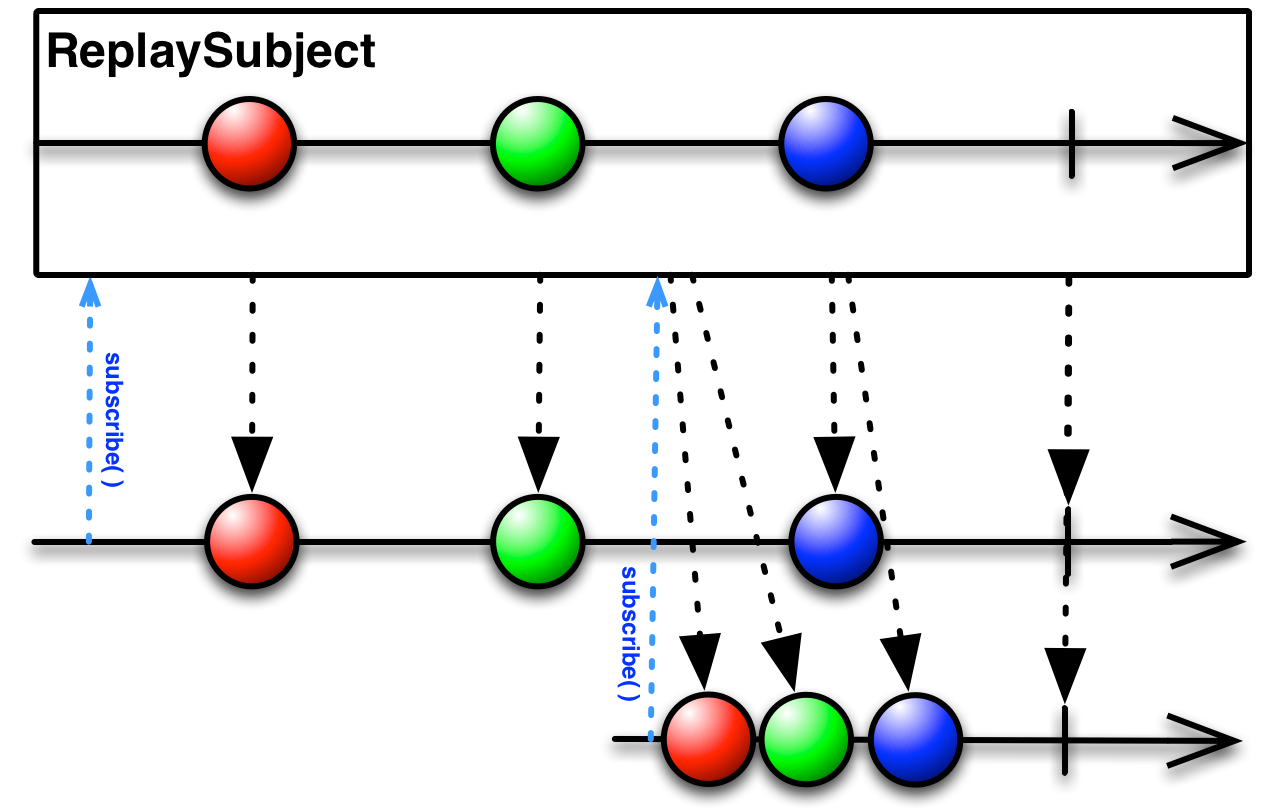
 *
*
*
*
* Example usage: *
*
{@code
ReplaySubject
*
* @param
* The internal buffer is backed by an {@link ArrayList} and starts with an initial capacity of 16. Once the
* number of items reaches this capacity, it will grow as necessary (usually by 50%). However, as the
* number of items grows, this causes frequent array reallocation and copying, and may hurt performance
* and latency. This can be avoided with the {@link #create(int)} overload which takes an initial capacity
* parameter and can be tuned to reduce the array reallocation frequency as needed.
*
* @param
* Use this method to avoid excessive array reallocation while the internal buffer grows to accomodate new
* items. For example, if you know that the buffer will hold 32k items, you can ask the
* {@code ReplaySubject} to preallocate its internal array with a capacity to hold that many items. Once
* the items start to arrive, the internal array won't need to grow, creating less garbage and no overhead
* due to frequent array-copying.
*
* @param
* This variant behaves like the regular unbounded {@code ReplaySubject} created via {@link #create()} but
* uses the structures of the bounded-implementation. This is by no means intended for the replacement of
* the original, array-backed and unbounded {@code ReplaySubject} due to the additional overhead of the
* linked-list based internal buffer. The sole purpose is to allow testing and reasoning about the behavior
* of the bounded implementations without the interference of the eviction policies.
*
* @param
* In this setting, the {@code ReplaySubject} holds at most {@code size} items in its internal buffer and
* discards the oldest item.
*
* When observers subscribe to a terminated {@code ReplaySubject}, they are guaranteed to see at most
* {@code size} {@code onNext} events followed by a termination event.
*
* If an observer subscribes while the {@code ReplaySubject} is active, it will observe all items in the
* buffer at that point in time and each item observed afterwards, even if the buffer evicts items due to
* the size constraint in the mean time. In other words, once an Observer subscribes, it will receive items
* without gaps in the sequence.
*
* @param
* In this setting, the {@code ReplaySubject} internally tags each observed item with a timestamp value
* supplied by the {@link Scheduler} and keeps only those whose age is less than the supplied time value
* converted to milliseconds. For example, an item arrives at T=0 and the max age is set to 5; at T>=5
* this first item is then evicted by any subsequent item or termination event, leaving the buffer empty.
*
* Once the subject is terminated, observers subscribing to it will receive items that remained in the
* buffer after the terminal event, regardless of their age.
*
* If an observer subscribes while the {@code ReplaySubject} is active, it will observe only those items
* from within the buffer that have an age less than the specified time, and each item observed thereafter,
* even if the buffer evicts items due to the time constraint in the mean time. In other words, once an
* observer subscribes, it observes items without gaps in the sequence except for any outdated items at the
* beginning of the sequence.
*
* Note that terminal notifications ({@code onError} and {@code onCompleted}) trigger eviction as well. For
* example, with a max age of 5, the first item is observed at T=0, then an {@code onCompleted} notification
* arrives at T=10. If an observer subscribes at T=11, it will find an empty {@code ReplaySubject} with just
* an {@code onCompleted} notification.
*
* @param
* In this setting, the {@code ReplaySubject} internally tags each received item with a timestamp value
* supplied by the {@link Scheduler} and holds at most {@code size} items in its internal buffer. It evicts
* items from the start of the buffer if their age becomes less-than or equal to the supplied age in
* milliseconds or the buffer reaches its {@code size} limit.
*
* When observers subscribe to a terminated {@code ReplaySubject}, they observe the items that remained in
* the buffer after the terminal notification, regardless of their age, but at most {@code size} items.
*
* If an observer subscribes while the {@code ReplaySubject} is active, it will observe only those items
* from within the buffer that have age less than the specified time and each subsequent item, even if the
* buffer evicts items due to the time constraint in the mean time. In other words, once an observer
* subscribes, it observes items without gaps in the sequence except for the outdated items at the beginning
* of the sequence.
*
* Note that terminal notifications ({@code onError} and {@code onCompleted}) trigger eviction as well. For
* example, with a max age of 5, the first item is observed at T=0, then an {@code onCompleted} notification
* arrives at T=10. If an observer subscribes at T=11, it will find an empty {@code ReplaySubject} with just
* an {@code onCompleted} notification.
*
* @param