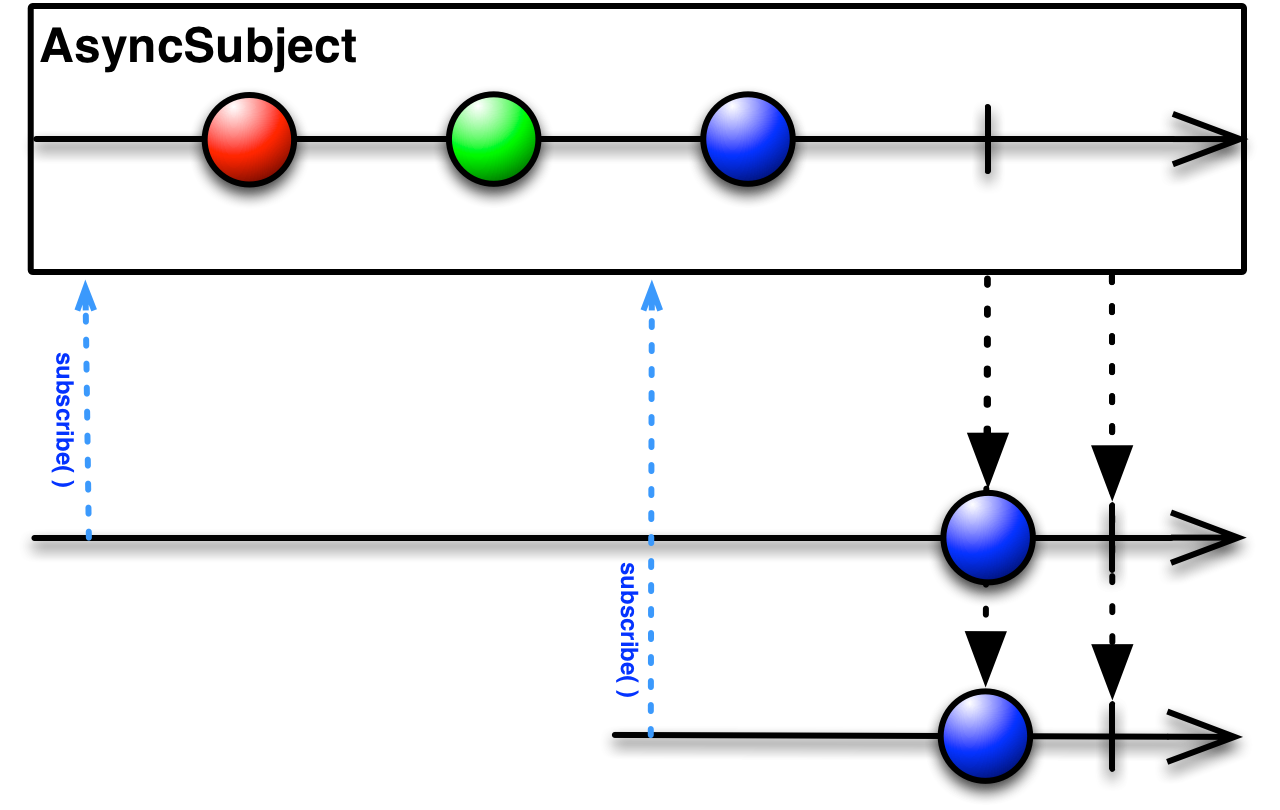
 *
*
*
*
* Example usage: *
*
{@code
// observer will receive no onNext events because the subject.onCompleted() isn't called.
AsyncSubject
*
* @param Use the {@link #getValue()} method to retrieve such a value. *
Note that unless {@link #hasCompleted()} or {@link #hasThrowable()} returns true, the value * retrieved by {@code getValue()} may get outdated. * @return true if and only if the subject has some value but not an error */ @Experimental @Override public boolean hasValue() { Object v = lastValue; Object o = state.get(); return !nl.isError(o) && nl.isNext(v); } /** * Check if the Subject has terminated with an exception. * @return true if the subject has received a throwable through {@code onError}. */ @Experimental @Override public boolean hasThrowable() { Object o = state.get(); return nl.isError(o); } /** * Check if the Subject has terminated normally. * @return true if the subject completed normally via {@code onCompleted()} */ @Experimental @Override public boolean hasCompleted() { Object o = state.get(); return o != null && !nl.isError(o); } /** * Returns the current value of the Subject if there is such a value and * the subject hasn't terminated with an exception. *
The method can return {@code null} for various reasons. Use {@link #hasValue()}, {@link #hasThrowable()} * and {@link #hasCompleted()} to determine if such {@code null} is a valid value, there was an * exception or the Subject terminated without receiving any value. * @return the current value or {@code null} if the Subject doesn't have a value, * has terminated with an exception or has an actual {@code null} as a value. */ @Experimental @Override public T getValue() { Object v = lastValue; Object o = state.get(); if (!nl.isError(o) && nl.isNext(v)) { return nl.getValue(v); } return null; } /** * Returns the Throwable that terminated the Subject. * @return the Throwable that terminated the Subject or {@code null} if the * subject hasn't terminated yet or it terminated normally. */ @Experimental @Override public Throwable getThrowable() { Object o = state.get(); if (nl.isError(o)) { return nl.getError(o); } return null; } @Override @Experimental @SuppressWarnings("unchecked") public T[] getValues(T[] a) { Object v = lastValue; Object o = state.get(); if (!nl.isError(o) && nl.isNext(v)) { T val = nl.getValue(v); if (a.length == 0) { a = (T[])Array.newInstance(a.getClass().getComponentType(), 1); } a[0] = val; if (a.length > 1) { a[1] = null; } } else if (a.length > 0) { a[0] = null; } return a; } }