# Microsoft Graph JavaScript Client Library
[](https://www.npmjs.com/package/@microsoft/microsoft-graph-client) [](https://travis-ci.org/microsoftgraph/msgraph-sdk-javascript) [](https://snyk.io/test/github/microsoftgraph/msgraph-sdk-javascript) [](https://github.com/microsoftgraph/msgraph-sdk-javascript) [](https://github.com/microsoftgraph/msgraph-sdk-javascript) [](https://www.npmjs.com/package/@microsoft/microsoft-graph-client)
The Microsoft Graph JavaScript client library is a lightweight wrapper around the Microsoft Graph API that can be used server-side and in the browser.
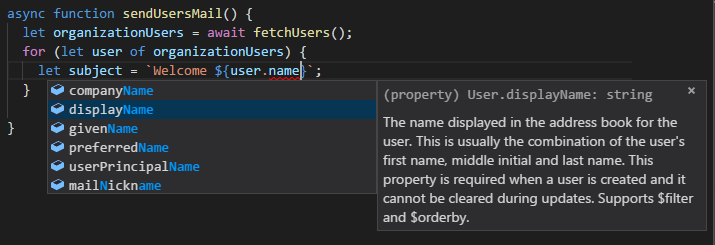
**Looking for IntelliSense on models (Users, Groups, etc.)? Check out the [Microsoft Graph Types](https://github.com/microsoftgraph/msgraph-typescript-typings) repository!**
[](https://github.com/microsoftgraph/msgraph-typescript-typings)
## Installation
### Via npm
```cmd
npm install @microsoft/microsoft-graph-client
```
import `@microsoft/microsoft-graph-client` into your module and also you will need polyfills for fetch like [isomorphic-fetch](https://www.npmjs.com/package/isomorphic-fetch).
```typescript
import "isomorphic-fetch";
import { Client } from "@microsoft/microsoft-graph-client";
```
### Via Script Tag
Include [graph-js-sdk.js](https://cdn.jsdelivr.net/npm/@microsoft/microsoft-graph-client/lib/graph-js-sdk.js) in your HTML page.
```HTML
```
In case your browser doesn't have support for [Fetch](https://developer.mozilla.org/en-US/docs/Web/API/Fetch_API) [[support](https://developer.mozilla.org/en-US/docs/Web/API/Fetch_API#Browser_compatibility)] or [Promise](https://developer.mozilla.org/en-US/docs/Web/JavaScript/Reference/Global_Objects/Promise) [[support](https://developer.mozilla.org/en-US/docs/Web/JavaScript/Reference/Global_Objects/Promise#Browser_compatibility)], you need to use polyfills like [github/fetch](https://github.com/github/fetch) for fetch and [es6-promise](https://github.com/stefanpenner/es6-promise) for promise.
```HTML
```
## Getting started
### 1. Register your application
Register your application to use Microsoft Graph API using one of the following supported authentication portals:
- [Microsoft Application Registration Portal](https://apps.dev.microsoft.com): Register a new application that works with Microsoft Accounts and/or organizational accounts using the unified V2 Authentication Endpoint.
- [Microsoft Azure Active Directory](https://manage.windowsazure.com): Register a new application in your tenant's Active Directory to support work or school users for your tenant or multiple tenants.
### 2. Authenticate for the Microsoft Graph service
The Microsoft Graph JavaScript Client Library has an adapter implementation ([ImplicitMSALAuthenticationProvider](src/ImplicitMSALAuthenticationProvider.ts)) for [MSAL](https://github.com/AzureAD/microsoft-authentication-library-for-js/tree/dev/lib/msal-core) (Microsoft Authentication Library) which takes care of getting the `accessToken`. MSAL library does not ship with this library, user has to include it externally (For including MSAL, refer [this](https://github.com/AzureAD/microsoft-authentication-library-for-js/tree/dev/lib/msal-core#installation)).
> **Important Note:** MSAL is supported only for frontend applications, for server-side authentication you have to implement your own AuthenticationProvider. Learn how you can create a [Custom Authentication Provider](./docs/CustomAuthenticationProvider.md).
#### Creating an instance of ImplicitMSALAuthenticationProvider in browser environment
Refer devDependencies in [package.json](./package.json) for the compatible msal version and update that version in below.
```html
```
```typescript
// Configuration options for MSAL @see https://github.com/AzureAD/microsoft-authentication-library-for-js/wiki/MSAL.js-1.0.0-api-release#configuration-options
const msalConfig = {
auth: {
clientId: "your_client_id", // Client Id of the registered application
redirectUri: "your_redirect_uri",
},
};
const graphScopes = ["user.read", "mail.send"]; // An array of graph scopes
// Important Note: This library implements loginPopup and acquireTokenPopup flow, remember this while initializing the msal
// Initialize the MSAL @see https://github.com/AzureAD/microsoft-authentication-library-for-js#1-instantiate-the-useragentapplication
const msalApplication = new Msal.UserAgentApplication(msalConfig);
const options = new MicrosoftGraph.MSALAuthenticationProviderOptions(graphScopes);
const authProvider = new MicrosoftGraph.ImplicitMSALAuthenticationProvider(msalApplication, options);
```
#### Creating an instance of ImplicitMSALAuthenticationProvider in node environment
Refer devDependencies in [package.json](./package.json) for the compatible msal version and update that version in below.
```cmd
npm install msal@
```
```typescript
import { UserAgentApplication } from "msal";
import { ImplicitMSALAuthenticationProvider } from "./node_modules/@microsoft/microsoft-graph-client/lib/src/ImplicitMSALAuthenticationProvider";
// An Optional options for initializing the MSAL @see https://github.com/AzureAD/microsoft-authentication-library-for-js/wiki/MSAL-basics#configuration-options
const msalConfig = {
auth: {
clientId: "your_client_id", // Client Id of the registered application
redirectUri: "your_redirect_uri",
},
};
const graphScopes = ["user.read", "mail.send"]; // An array of graph scopes
// Important Note: This library implements loginPopup and acquireTokenPopup flow, remember this while initializing the msal
// Initialize the MSAL @see https://github.com/AzureAD/microsoft-authentication-library-for-js#1-instantiate-the-useragentapplication
const msalApplication = new UserAgentApplication(msalConfig);
const options = new MicrosoftGraph.MSALAuthenticationProviderOptions(graphScopes);
const authProvider = new ImplicitMSALAuthenticationProvider(msalApplication, options);
```
User can integrate own preferred authentication library by implementing `IAuthenticationProvider` interface. Refer implementing [Custom Authentication Provider](./docs/CustomAuthenticationProvider.md).
### 3. Initialize a Microsoft Graph Client object with an authentication provider
An instance of the **Client** class handles requests to Microsoft Graph API and processing the responses. To create a new instance of this class, you need to provide an instance of [`IAuthenticationProvider`](src/IAuthenticationProvider.ts) which needs to be passed as a value for `authProvider` key in [`ClientOptions`](src/IClientOptions.ts) to a static initializer method `Client.initWithMiddleware`.
#### For browser environment
```typescript
const options = {
authProvider, // An instance created from previous step
};
const Client = MicrosoftGraph.Client;
const client = Client.initWithMiddleware(options);
```
#### For node environment
```typescript
import { Client } from "@microsoft/microsoft-graph-client";
const options = {
authProvider, // An instance created from previous step
};
const client = Client.initWithMiddleware(options);
```
For more information on initializing client, refer [this document](./docs/CreatingClientInstance.md).
### 4. Make requests to the graph
Once you have authentication setup and an instance of Client, you can begin to make calls to the service. All requests should be start with `client.api(path)` and end with an [action](./docs/Actions.md).
Getting user details
```typescript
try {
let userDetails = await client.api("/me").get();
console.log(userDetails);
} catch (error) {
throw error;
}
```
Sending an email to the recipients
```typescript
// Construct email object
const mail = {
subject: "Microsoft Graph JavaScript Sample",
toRecipients: [
{
emailAddress: {
address: "example@example.com",
},
},
],
body: {
content: "MicrosoftGraph JavaScript Sample
Check out https://github.com/microsoftgraph/msgraph-sdk-javascript",
contentType: "html",
},
};
try {
let response = await client.api("/me/sendMail").post({ message: mail });
console.log(response);
} catch (error) {
throw error;
}
```
For more information, refer: [Calling Pattern](docs/CallingPattern.md), [Actions](docs/Actions.md), [Query Params](docs/QueryParameters.md), [API Methods](docs/OtherAPIs.md) and [more](docs/).
## Documentation
- [Batching](docs/content/Batching.md)
- [Large File Upload Task](docs/tasks/LargeFileUploadTask.md)
- [Page Iterator](docs/tasks/PageIterator.md)
- [Actions](docs/Actions.md)
- [Query Parameters](docs/QueryParameters.md)
- [Other APIs](docs/OtherAPIs.md)
- [Getting Raw Response](docs/GettingRawResponse.md)
## Questions and comments
We'd love to get your feedback about the Microsoft Graph JavaScript client library. You can send your questions and suggestions to us in the [Issues](https://github.com/microsoftgraph/msgraph-sdk-javascript/issues) section of this repository.
## Contributing
Please see the [contributing guidelines](CONTRIBUTING.md).
## Additional resources
- [Microsoft Graph website](https://graph.microsoft.io)
- [Microsoft Graph TypeScript types](https://github.com/microsoftgraph/msgraph-typescript-typings/)
- [Build Angular single-page apps with Microsoft Graph](https://github.com/microsoftgraph/msgraph-training-angularspa)
- [Build Node.js Express apps with Microsoft Graph](https://github.com/microsoftgraph/msgraph-training-nodeexpressapp)
- [Office Dev Center](http://dev.office.com/)
## Third Party Notices
See [Third Party Notices](./THIRD%20PARTY%20NOTICES) for information on the packages that are included in the [package.json](./package.json)
## Security Reporting
If you find a security issue with our libraries or services please report it to [secure@microsoft.com](mailto:secure@microsoft.com) with as much detail as possible. Your submission may be eligible for a bounty through the [Microsoft Bounty](http://aka.ms/bugbounty) program. Please do not post security issues to GitHub Issues or any other public site. We will contact you shortly upon receiving the information. We encourage you to get notifications of when security incidents occur by visiting [this page](https://technet.microsoft.com/en-us/security/dd252948) and subscribing to Security Advisory Alerts.
## License
Copyright (c) Microsoft Corporation. All rights reserved. Licensed under the MIT License (the "[License](./LICENSE)");
## We Value and Adhere to the Microsoft Open Source Code of Conduct
This project has adopted the [Microsoft Open Source Code of Conduct](https://opensource.microsoft.com/codeofconduct/). For more information see the [Code of Conduct FAQ](https://opensource.microsoft.com/codeofconduct/faq/) or contact [opencode@microsoft.com](mailto:opencode@microsoft.com) with any additional questions or comments.