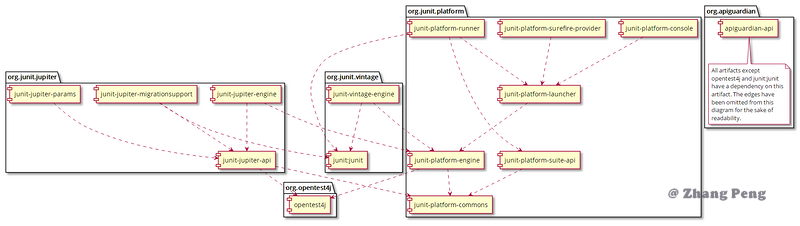
## 2. JUnit 注解
| Annotation | Description |
| -------------------- | --------------------------------------------------------------------------------------------------------------------------------------------------------------------------------------------------------------------------------------------------------------------------------------------------------------------------------------------------------------------------------------------------------------------------------------------------------------- |
| `@Test` | Denotes that a method is a test method. Unlike JUnit 4’s `@Test` annotation, this annotation does not declare any attributes, since test extensions in JUnit Jupiter operate based on their own dedicated annotations. Such methods are _inherited_ unless they are _overridden_. |
| `@ParameterizedTest` | Denotes that a method is a [parameterized test](https://junit.org/junit5/docs/current/user-guide/#writing-tests-parameterized-tests). Such methods are _inherited_ unless they are _overridden_. |
| `@RepeatedTest` | Denotes that a method is a test template for a [repeated test](https://junit.org/junit5/docs/current/user-guide/#writing-tests-repeated-tests). Such methods are _inherited_ unless they are _overridden_. |
| `@TestFactory` | Denotes that a method is a test factory for [dynamic tests](https://junit.org/junit5/docs/current/user-guide/#writing-tests-dynamic-tests). Such methods are _inherited_ unless they are _overridden_. |
| `@TestInstance` | Used to configure the [test instance lifecycle](https://junit.org/junit5/docs/current/user-guide/#writing-tests-test-instance-lifecycle) for the annotated test class. Such annotations are _inherited_. |
| `@TestTemplate` | Denotes that a method is a [template for test cases](https://junit.org/junit5/docs/current/user-guide/#writing-tests-test-templates) designed to be invoked multiple times depending on the number of invocation contexts returned by the registered [providers](https://junit.org/junit5/docs/current/user-guide/#extensions-test-templates). Such methods are _inherited_ unless they are _overridden_. |
| `@DisplayName` | Declares a custom display name for the test class or test method. Such annotations are not _inherited_. |
| `@BeforeEach` | Denotes that the annotated method should be executed _before_ **each** `@Test`, `@RepeatedTest`, `@ParameterizedTest`, or `@TestFactory` method in the current class; analogous to JUnit 4’s `@Before`. Such methods are _inherited_ unless they are _overridden_. |
| `@AfterEach` | Denotes that the annotated method should be executed _after_ **each** `@Test`, `@RepeatedTest`, `@ParameterizedTest`, or `@TestFactory` method in the current class; analogous to JUnit 4’s `@After`. Such methods are _inherited_ unless they are _overridden_. |
| `@BeforeAll` | Denotes that the annotated method should be executed _before_ **all** `@Test`, `@RepeatedTest`, `@ParameterizedTest`, and `@TestFactory` methods in the current class; analogous to JUnit 4’s `@BeforeClass`. Such methods are _inherited_ (unless they are _hidden_ or _overridden_) and must be `static` (unless the "per-class" [test instance lifecycle](https://junit.org/junit5/docs/current/user-guide/#writing-tests-test-instance-lifecycle) is used). |
| `@AfterAll` | Denotes that the annotated method should be executed _after_ **all** `@Test`, `@RepeatedTest`, `@ParameterizedTest`, and `@TestFactory` methods in the current class; analogous to JUnit 4’s `@AfterClass`. Such methods are _inherited_ (unless they are _hidden_ or _overridden_) and must be `static` (unless the "per-class" [test instance lifecycle](https://junit.org/junit5/docs/current/user-guide/#writing-tests-test-instance-lifecycle) is used). |
| `@Nested` | Denotes that the annotated class is a nested, non-static test class. `@BeforeAll` and `@AfterAll`methods cannot be used directly in a `@Nested` test class unless the "per-class" [test instance lifecycle](https://junit.org/junit5/docs/current/user-guide/#writing-tests-test-instance-lifecycle) is used. Such annotations are not _inherited_. |
| `@Tag` | Used to declare _tags_ for filtering tests, either at the class or method level; analogous to test groups in TestNG or Categories in JUnit 4. Such annotations are _inherited_ at the class level but not at the method level. |
| `@Disabled` | Used to _disable_ a test class or test method; analogous to JUnit 4’s `@Ignore`. Such annotations are not _inherited_. |
| `@ExtendWith` | Used to register custom [extensions](https://junit.org/junit5/docs/current/user-guide/#extensions). Such annotations are _inherited_. |
## 3. 编写单元测试
### 3.1. 基本的单元测试类和方法
```java
import org.junit.jupiter.api.*;
import org.slf4j.Logger;
import org.slf4j.LoggerFactory;
class Junit5StandardTests {
private static final Logger LOGGER = LoggerFactory.getLogger(Junit5StandardTests.class);
@BeforeAll
static void beforeAll() {
LOGGER.info("call beforeAll()");
}
@BeforeEach
void beforeEach() {
LOGGER.info("call beforeEach()");
}
@Test
void succeedingTest() {
LOGGER.info("call succeedingTest()");
}
@Test
void failingTest() {
LOGGER.info("call failingTest()");
// fail("a failing test");
}
@Test
@Disabled("for demonstration purposes")
void skippedTest() {
LOGGER.info("call skippedTest()");
// not executed
}
@AfterEach
void afterEach() {
LOGGER.info("call afterEach()");
}
@AfterAll
static void afterAll() {
LOGGER.info("call afterAll()");
}
}
```
### 3.2. 定制测试类和方法的显示名称
支持普通字符、特殊符号、emoji
```java
import org.junit.jupiter.api.DisplayName;
import org.junit.jupiter.api.Test;
@DisplayName("A special test case")
class JunitDisplayNameDemo {
@Test
@DisplayName("Custom test name containing spaces")
void testWithDisplayNameContainingSpaces() { }
@Test
@DisplayName("╯°□°)╯")
void testWithDisplayNameContainingSpecialCharacters() { }
@Test
@DisplayName("😱")
void testWithDisplayNameContainingEmoji() { }
}
```
### 3.3. 断言(Assertions)
```java
import org.junit.jupiter.api.BeforeAll;
import org.junit.jupiter.api.Test;
import static java.time.Duration.ofMillis;
import static java.time.Duration.ofMinutes;
import static org.junit.jupiter.api.Assertions.*;
class AssertionsDemo {
private static Person person;
@BeforeAll
public static void beforeAll() {
person = new Person("John", "Doe");
}
@Test
void standardAssertions() {
assertEquals(2, 2);
assertEquals(4, 4, "The optional assertion message is now the last parameter.");
assertTrue('a' < 'b', () -> "Assertion messages can be lazily evaluated -- "
+ "to avoid constructing complex messages unnecessarily.");
}
@Test
void groupedAssertions() {
// In a grouped assertion all assertions are executed, and any
// failures will be reported together.
assertAll("person", () -> assertEquals("John", person.getFirstName()),
() -> assertEquals("Doe", person.getLastName()));
}
@Test
void dependentAssertions() {
// Within a code block, if an assertion fails the
// subsequent code in the same block will be skipped.
assertAll("properties", () -> {
String firstName = person.getFirstName();
assertNotNull(firstName);
// Executed only if the previous assertion is valid.
assertAll("first name", () -> assertTrue(firstName.startsWith("J")),
() -> assertTrue(firstName.endsWith("n")));
}, () -> {
// Grouped assertion, so processed independently
// of results of first name assertions.
String lastName = person.getLastName();
assertNotNull(lastName);
// Executed only if the previous assertion is valid.
assertAll("last name", () -> assertTrue(lastName.startsWith("D")),
() -> assertTrue(lastName.endsWith("e")));
});
}
@Test
void exceptionTesting() {
Throwable exception = assertThrows(IllegalArgumentException.class, () -> {
throw new IllegalArgumentException("a message");
});
assertEquals("a message", exception.getMessage());
}
@Test
void timeoutNotExceeded() {
// The following assertion succeeds.
assertTimeout(ofMinutes(2), () -> {
// Perform task that takes less than 2 minutes.
});
}
@Test
void timeoutNotExceededWithResult() {
// The following assertion succeeds, and returns the supplied object.
String actualResult = assertTimeout(ofMinutes(2), () -> {
return "a result";
});
assertEquals("a result", actualResult);
}
@Test
void timeoutNotExceededWithMethod() {
// The following assertion invokes a method reference and returns an object.
String actualGreeting = assertTimeout(ofMinutes(2), AssertionsDemo::greeting);
assertEquals("Hello, World!", actualGreeting);
}
@Test
void timeoutExceeded() {
// The following assertion fails with an error message similar to:
// execution exceeded timeout of 10 ms by 91 ms
assertTimeout(ofMillis(10), () -> {
// Simulate task that takes more than 10 ms.
Thread.sleep(100);
});
}
@Test
void timeoutExceededWithPreemptiveTermination() {
// The following assertion fails with an error message similar to:
// execution timed out after 10 ms
assertTimeoutPreemptively(ofMillis(10), () -> {
// Simulate task that takes more than 10 ms.
Thread.sleep(100);
});
}
private static String greeting() {
return "Hello, World!";
}
}
```
### 3.4. 假想(Assumptions)
```java
import static org.junit.jupiter.api.Assertions.assertEquals;
import static org.junit.jupiter.api.Assumptions.assumeTrue;
import static org.junit.jupiter.api.Assumptions.assumingThat;
import org.junit.jupiter.api.Test;
class AssumptionsDemo {
@Test
void testOnlyOnCiServer() {
assumeTrue("CI".equals(System.getenv("ENV")));
// remainder of test
}
@Test
void testOnlyOnDeveloperWorkstation() {
assumeTrue("DEV".equals(System.getenv("ENV")),
() -> "Aborting test: not on developer workstation");
// remainder of test
}
@Test
void testInAllEnvironments() {
assumingThat("CI".equals(System.getenv("ENV")),
() -> {
// perform these assertions only on the CI server
assertEquals(2, 2);
});
// perform these assertions in all environments
assertEquals("a string", "a string");
}
}
```
### 3.5. 禁用
禁用单元测试类示例:
```java
import org.junit.jupiter.api.Disabled;
import org.junit.jupiter.api.Test;
@Disabled
class DisabledClassDemo {
@Test
void testWillBeSkipped() {
}
}
```
禁用单元测试方法示例:
```java
import org.junit.jupiter.api.Disabled;
import org.junit.jupiter.api.Test;
class DisabledTestsDemo {
@Disabled
@Test
void testWillBeSkipped() {
}
@Test
void testWillBeExecuted() {
}
}
```
### 3.6. 测试条件
#### 操作系统条件
```java
@Test
@EnabledOnOs(MAC)
void onlyOnMacOs() {
// ...
}
@TestOnMac
void testOnMac() {
// ...
}
@Test
@EnabledOnOs({ LINUX, MAC })
void onLinuxOrMac() {
// ...
}
@Test
@DisabledOnOs(WINDOWS)
void notOnWindows() {
// ...
}
@Target(ElementType.METHOD)
@Retention(RetentionPolicy.RUNTIME)
@Test
@EnabledOnOs(MAC)
@interface TestOnMac {
}
```
#### Java 运行时版本条件
```java
@Test
@EnabledOnJre(JAVA_8)
void onlyOnJava8() {
// ...
}
@Test
@EnabledOnJre({ JAVA_9, JAVA_10 })
void onJava9Or10() {
// ...
}
@Test
@DisabledOnJre(JAVA_9)
void notOnJava9() {
// ...
}
```
#### 系统属性条件
```java
@Test
@EnabledIfSystemProperty(named = "os.arch", matches = ".*64.*")
void onlyOn64BitArchitectures() {
// ...
}
@Test
@DisabledIfSystemProperty(named = "ci-server", matches = "true")
void notOnCiServer() {
// ...
}
```
### 3.7. 嵌套测试
```java
import static org.junit.jupiter.api.Assertions.assertEquals;
import static org.junit.jupiter.api.Assertions.assertFalse;
import static org.junit.jupiter.api.Assertions.assertThrows;
import static org.junit.jupiter.api.Assertions.assertTrue;
import java.util.EmptyStackException;
import java.util.Stack;
import org.junit.jupiter.api.BeforeEach;
import org.junit.jupiter.api.DisplayName;
import org.junit.jupiter.api.Nested;
import org.junit.jupiter.api.Test;
@DisplayName("A stack")
class TestingAStackDemo {
Stack